
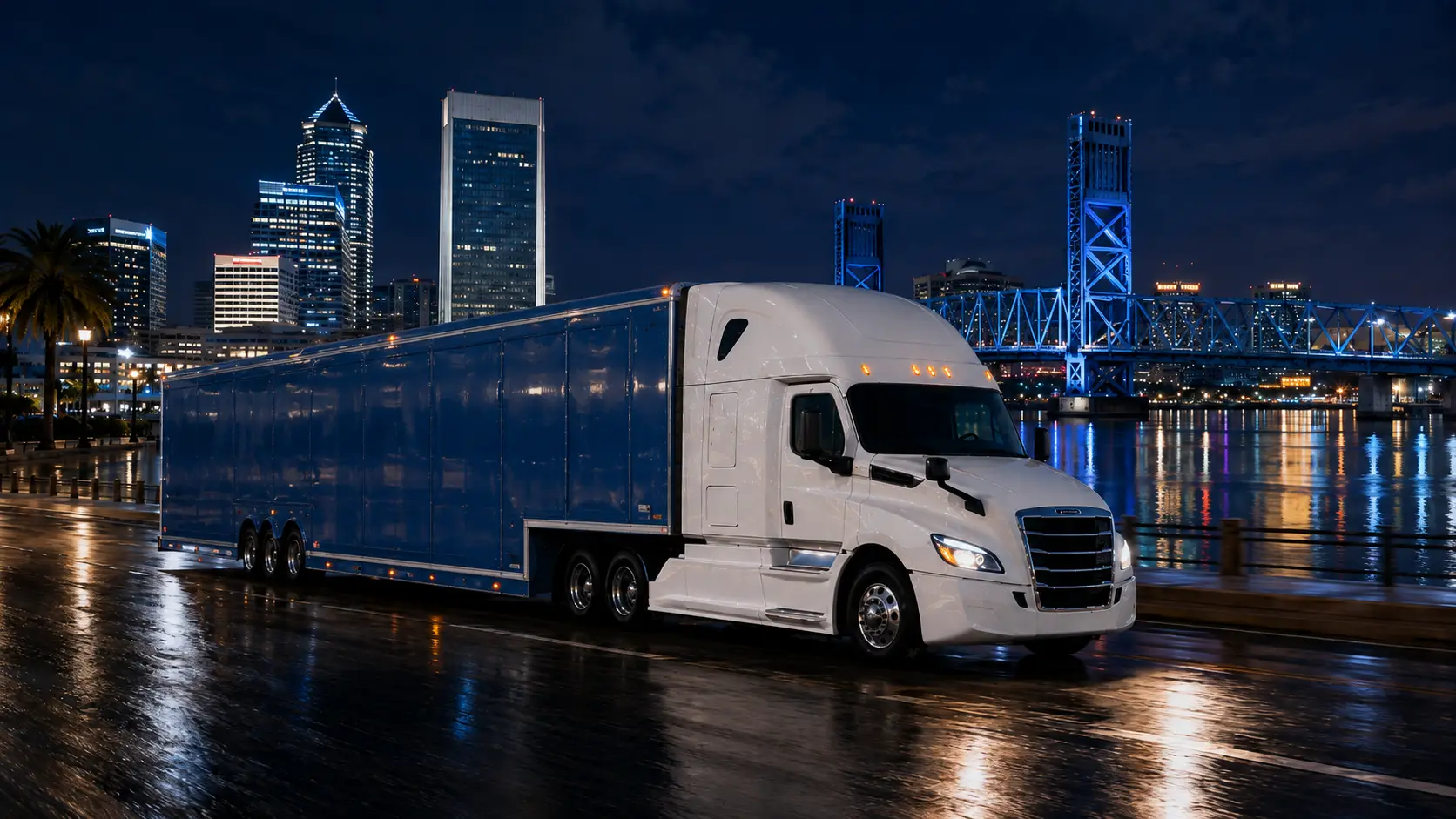
Enclosed Vehicle Shipping
Enclosed vehicle shipping costs about 80 percent more than open transport on the same route. On a $1,000 open move that is roughly $1,800. Coast to coast it can reach $4,500. Most people who ask about it do not need it, and we would rather tell you that than sell it to you.
Almost nobody publishes the enclosed number. You will find pages describing the trailer, the peace of mind and the extra care, and then a form. The number is the thing you actually want, so it is at the top of this page and there is a table below showing what it works out to at every distance.
Roughly one shipment in twenty goes enclosed. The rest go on an open deck, arrive fine, and cost a great deal less. What follows is how to work out which of those two your car is.
How much does enclosed vehicle shipping cost?
Take the open price for your route and add about 80 percent. The table works that out against the distance bands we publish, for an operable mid-size vehicle as of September 2026.
| Route type | Distance | Open transport | Enclosed | The difference |
|---|---|---|---|---|
| Short regional | Under 500 mi | $450–$900 | $800–$1,625 | Around $350 to $725 more |
| Mid distance | 500–1,500 mi | $900–$1,600 | $1,625–$2,875 | Around $725 to $1,275 more |
| Long haul | 1,500–2,500 mi | $1,250–$2,100 | $2,250–$3,775 | Around $1,000 to $1,675 more |
| Cross country | 2,500 mi and over | $1,600–$2,500 | $2,875–$4,500 | Around $1,275 to $2,000 more |
Estimates for an operable mid-size vehicle, and fuel moves them. A wide car, a long wheelbase or a lift gate requirement can push a shipment above the band because it takes more of the trailer. Non-running vehicles add $200 or more again. The calculator prices your exact route both ways so you can see the two numbers side by side.
Why is enclosed so much more expensive?
Two reasons, and neither one is a markup. The trailer carries fewer cars, and there are fewer trailers.
Fewer cars per trip
An open deck holds seven to ten vehicles. A hard-sided trailer holds two to six, and the tallest ones fewer still. The truck burns the same fuel over the same distance either way, so each car on board pays a much larger share of it. That is most of the 80 percent right there.
Fewer trailers on the road
Enclosed equipment is a small minority of what runs the interstates. The trucks that do exist stay busy, which keeps rates firm and makes the wait for one longer. It is also why enclosed capacity is thinner in some regions than others.
Capacity is not spread evenly. Around Charlotte and Mooresville, where the race industry keeps hard-sided trailers moving constantly, enclosed slots are easier to find than in most of the country. Rural routes are the opposite, and that is where an enclosed booking is most likely to need patience.
Does your car actually need it?
Most cars do not, and we would rather say so than take the booking. Here is the test we would apply if it were our own car.
Open is the right call when
The car is insured for its book value, it gets driven in the rain, and a stone chip would be an annoyance rather than a loss. That covers the overwhelming majority of vehicles that move in this country.
Enclosed is worth it when
The paint is original or freshly done, the parts are hard to source, the car is going to a show or an auction, or it sits low enough to need a lift gate rather than a ramp.
Winter is its own case
Road salt between December and March is the one seasonal argument for enclosed on an otherwise ordinary car, particularly on a long haul that crosses the northern states.
The thing enclosed does not buy you is better handling. Loading, strapping and driving come down to the person behind the wheel, and that is the same question on either trailer. What you are paying for is the roof and the walls.
What does the trailer actually do for the car?
It takes the weather and the road out of the equation for the whole trip. Specifically, these are the things an open deck exposes a car to and a hard-sided one does not.
Off the road
Stone chips thrown up by the truck ahead, road spray, and winter salt. On a 2,000 mile run an open car arrives needing a wash. That is normal, and for most cars it is fine.
Out of the weather
Hail, heavy rain, strong sun on a long southern route, and tree sap or bird mess on an overnight stop. Nothing here damages a normal car. All of it matters on fresh paintwork.
Out of sight
A car nobody can see at a truck stop overnight is a car nobody thinks about. On a recognizable or valuable vehicle this is a real part of what you are buying.
Your car never sits anywhere. It goes from your address straight onto the carrier and stays covered under Carrier Cargo Insurance for the entire trip. Smart Auto Move runs no terminals and no holding lots, so an enclosed car is inside the trailer from collection to delivery.
What if the car sits too low for a ramp?
Then it wants a lift gate, and that is a specific request rather than a general one. Below roughly five inches of ground clearance, a standard ramp angle will catch a splitter or an exhaust before the car is on the deck.
Tell us at quote time
Ground clearance, any splitter or body kit, whether it is lowered, and how it starts if there is a procedure. Lift-gate trailers are a subset of a subset, so dispatch needs to go looking rather than assign the next available truck.
What it changes
The wait, mostly. The price moves if the car is unusually wide or long enough to take more than one slot. Finding this out on collection day is the expensive version, because it means rescheduling around a truck that cannot load it.
How does booking enclosed transport work?
Four steps, and on enclosed the first one carries more weight than usual. The details you give at quote stage decide which trucks can even take the job.
Price it both ways
Get the open number and the enclosed number for the same route and look at them together. That is the decision, and it is easier to make with two figures than with a description.
Describe the car properly
Clearance, modifications, whether it runs, and any starting procedure. Two minutes here is what stops a truck arriving that cannot load it.
Confirm and wait for the right truck
Standard gives a six day collection window, Expedited three, starting on the date you ask for. On enclosed, a wider window genuinely helps. The Smart Price Promise holds the figure from here.
Collection and delivery
You and the driver record the car's condition together before it goes in, and check it against the same record when it comes out. Do it in daylight if you can.
What our customers say
More than 120 Google reviews across our offices, averaging 4.7.
Enclosed vehicle shipping questions
How much does enclosed vehicle shipping cost?
About 80 percent more than open transport on the same route. That works out to roughly $800 to $1,625 under 500 miles, $1,625 to $2,875 on a mid-range route, and $2,875 to $4,500 coast to coast, for an operable mid-size vehicle as of September 2026. Price the open version first and the enclosed figure follows from it.
Why is enclosed so much more expensive?
Two reasons, and neither is a markup. An open trailer carries seven to ten cars while a hard-sided one carries two to six, so each car pays a larger share of the same trip. And there are far fewer enclosed trucks on the road, so the ones running are in steady demand. The 80 percent is what the equipment costs, not what we add.
Does my car actually need enclosed transport?
Probably not, and we would rather say so. Roughly one shipment in twenty goes enclosed. If the car is insured for its book value, gets driven in the rain, and has paint you would touch up rather than restore, open transport puts it on the same roads with the same coverage for a lot less. Enclosed earns its money on cars where a stone chip is a real loss.
When is enclosed clearly the right call?
A classic or collector car, an exotic, a restoration, anything with fresh paint or a wrap, a vehicle heading to a show or an auction, and anything under about five inches of ground clearance that needs a lift gate rather than a ramp. Winter shipments through the salt belt are the other clear case.
What does the trailer actually protect against?
Road spray, stone chips off the truck ahead, road salt in winter, tree sap and bird mess on a long haul, and hail. It also keeps the car out of sight, which matters at a truck stop overnight. It is not protection against handling, which comes down to the driver either way.
Is my car insured differently in an enclosed trailer?
The mechanism is the same. Your vehicle travels under Carrier Cargo Insurance, which belongs to the carrier rather than to Smart Auto Move, and once your order is assigned to a truck the certificate is on file and we can send it right away. Enclosed carriers often hold higher cargo limits, which is worth asking about on a high-value car.
How much longer does enclosed take?
The trip is the same. The wait for a truck can be longer, because there are fewer of them. Transit runs one to three days regionally, three to six mid-range and seven to ten coast to coast, the same as open. Give the pickup window room: six days on Standard, three on Expedited, starting from the date you ask for.
Can I put personal items in the car?
Usually yes, within reason. Most drivers will take a few things as a courtesy. Keep it under about 100 pounds, pack it neatly, and keep it out of sight from outside the car. Think a few boxes in the trunk rather than a carload. The one thing to know is that you are paying to move the vehicle, so the carrier's insurance covers the car itself. Keep anything you would hate to lose with you.
How do I prepare a car for an enclosed shipment?
The same as any shipment, with two additions. Wash it, take dated photos of all four corners, leave about a quarter tank, and switch off the alarm and toll tag. Then tell us the ground clearance and whether it has a splitter, a body kit or a low exhaust, and say if it needs a particular starting procedure. A driver who knows before he arrives loads it without drama.
Can you ship a car that does not run in an enclosed trailer?
Yes, as long as it rolls, brakes and steers, and the trailer carries a winch. Say so at quote time. There is no flat fee for it, though it typically runs $200 or more above the price of shipping the same car running, and on enclosed the pool of suitable trucks is smaller again.
How far ahead should I book enclosed?
Two to three weeks, which is longer than open, simply because there are fewer trucks to catch. If the car is going to a show or an auction with a fixed date, book as soon as you have the date and give a wide collection window at the front end.
How does payment work, and can I cancel?
A deposit is due when you book and the balance is paid to the driver at delivery, usually by cashier's check, money order or cash. You can also put the whole amount on a credit card at booking. Cancel any time before we assign a carrier and your deposit comes back to you. After that it carries over to a later shipment instead.
How do I avoid a bad enclosed quote?
Watch for the quote that sits far below the rest. Enclosed is where bait pricing does the most damage, because the gap between a quoted number and one an enclosed carrier will actually accept is wide. If four companies say $3,000 and the fifth says $1,900, ask whether that is a confirmed rate or a mistake, and search that company for bait and switch complaints before you book.