
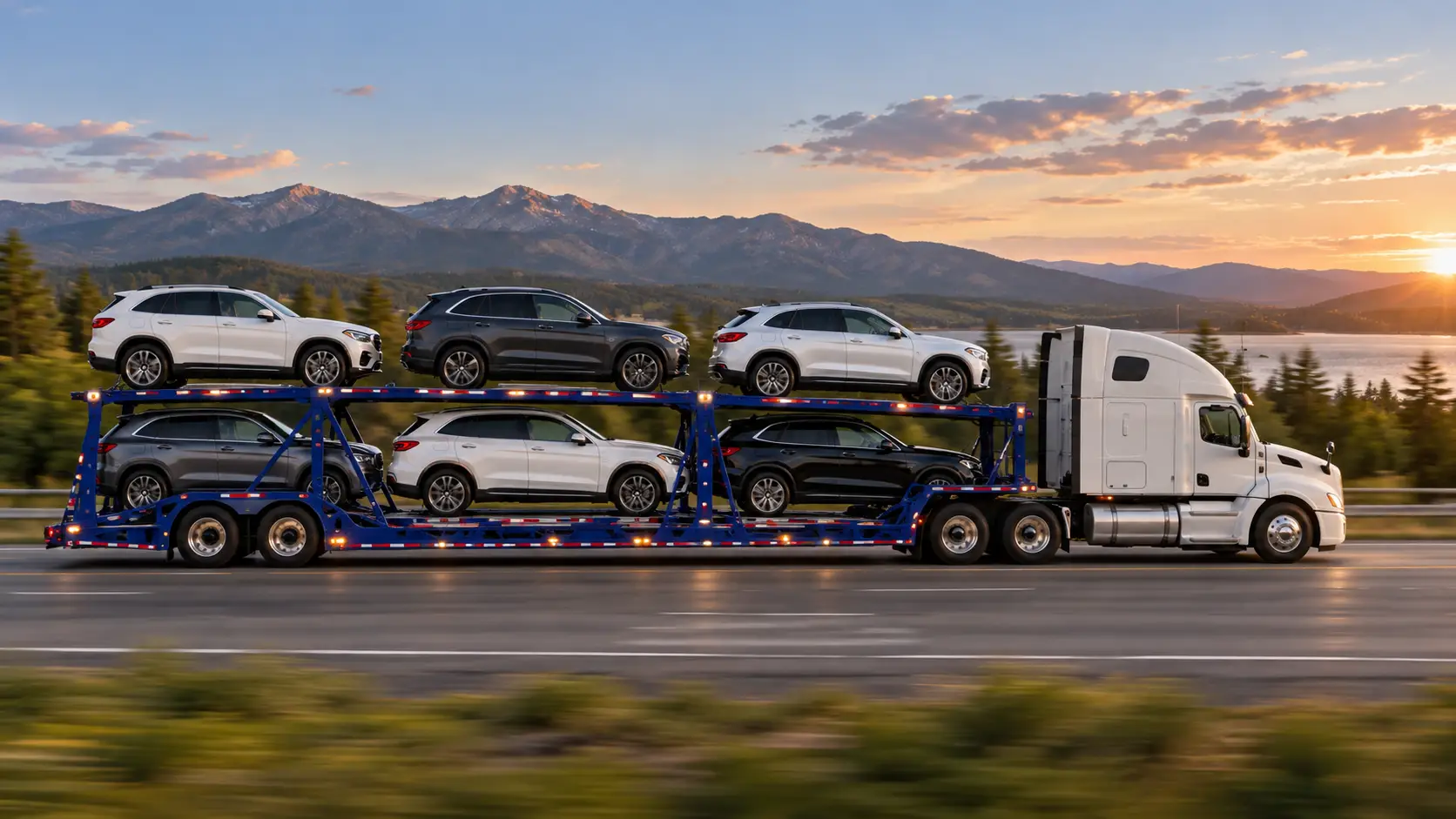
Car Shipping Cost
Written by Richard Avery, President of Smart Auto Move · USDOT 2887232 · MC 969368
The cost to ship a car is typically $450 to $2,500 on an open trailer in 2026, and distance sets the band: about $450 to $900 under 500 miles, $900 to $1,600 from 500 to 1,500 miles, $1,250 to $2,100 from 1,500 to 2,500 miles, and $1,600 to $2,500 past 2,500 miles. Those bands are the frame. The rest of this page is about the part almost nobody explains, which is why one shipment lands at the bottom of its band and another at the top.
How much does it cost to ship a car in 2026?
Start with the four distance bands. These hold across the country for an operable mid-size vehicle moving door to door on an open trailer.
$450 to $900
Under 500 miles. One to three days on the road. Regional moves within a state or between neighboring states.
$900 to $1,600
500 to 1,500 miles. Two to five days on the road. Most cross-region moves, and the busiest band we handle.
$1,250 to $2,100
1,500 to 2,500 miles. Four to eight days on the road. Midwest to either coast, and the long southern runs.
$1,600 to $2,500
Over 2,500 miles. Seven to ten days on the road. True coast to coast, in both directions.
Days count from the moment the car is loaded. Your pickup window sits in front of them. Oversized, modified, non-running and enclosed shipments price on their own terms.
Twelve real car shipping prices we publish
Not estimates and not national averages. These are the open transport prices on twelve routes we publish across the site, shortest to longest, reviewed September 2026. Read down the price column and you will see the point of this page.
| Route | Distance | Days on the road | Open transport |
|---|---|---|---|
| Atlanta, GA to Clermont, FL SHORTEST RUN | 425 miles | 1 to 3 days | $575 to $700 |
| Raleigh, NC to Kissimmee, FL BELOW BAND | 617 miles | 2 to 4 days | $625 to $775 |
| Durham, NC to Miami, FL BELOW BAND | 831 miles | 3 to 5 days | $725 to $875 |
| Chicago, IL to Dallas, TX BELOW BAND | 925 miles | 2 to 3 days | $800 to $950 |
| Naperville, IL to San Antonio, TX | 1,175 miles | 3 to 4 days | $950 to $1,100 |
| Cary, NC to Dallas, TX FIVE MILES FARTHER | 1,180 miles | 3 to 4 days | $1,325 to $1,475 |
| Rockford, IL to Spokane, WA BELOW BAND | 1,715 miles | 4 to 6 days | $1,050 to $1,250 |
| Bloomington, IL to Los Angeles, CA | 1,931 miles | 4 to 6 days | $1,125 to $1,325 |
| Chicago, IL to Seattle, WA | 2,065 miles | 5 to 7 days | $1,250 to $1,450 |
| Aurora, IL to San Francisco, CA | 2,110 miles | 5 to 7 days | $1,325 to $1,525 |
| Boston, MA to Los Angeles, CA | 2,984 miles | 7 to 10 days | $1,850 to $2,150 |
| Worcester, MA to San Jose, CA LONGEST RUN | 3,092 miles | 8 to 10 days | $1,950 to $2,250 |
Operable mid-size vehicle, open trailer, door to door. Distances are driving miles. Each of these routes has its own page with the full city list, and the links are at the foot of this page.
Distance gives you the band. Direction decides where you land in it.
This is the single most useful thing to understand about what car shipping costs, and it is the reason a mileage figure will always steer you wrong.
Five miles apart, and the gap is roughly $375. Neither number is wrong and neither route is a bad deal. They are simply two different jobs that happen to be the same length.
Why this is good news more often than not. Most people ship out of or into a reasonably busy market, which means most people benefit from this rather than losing to it. Look again at the four rows marked below band in the table: Raleigh to Kissimmee at 617 miles comes in under $800, and Rockford to Spokane at 1,715 miles comes in under $1,300. Both sit beneath the band their distance would suggest, because both run with the flow of freight rather than against it. A mileage-based estimate would have quoted you higher on every one of them.
Car Shipping Cost Questions
The questions people actually ask about price, answered with the numbers we publish rather than with national averages.
How much does it cost to ship a car in 2026?
Between $450 and $2,500 on an open trailer, and distance sets the band. About $450 to $900 under 500 miles, $900 to $1,600 from 500 to 1,500 miles, $1,250 to $2,100 from 1,500 to 2,500 miles, and $1,600 to $2,500 past 2,500 miles. Those are operable mid-size vehicles moving door to door. The table on this page shows twelve real routes we publish, and several of them land below the band for their distance, which is the part worth understanding before you book.
Is car shipping priced by the mile?
No, and any figure quoted that way will mislead you. A 400-mile move and a 3,000-mile move do not scale against each other, because loading, paperwork and the driver's time at each end cost the same whether the trailer then travels one state or ten. Distance gives you the band. What decides where you land inside it is the direction you are going, how busy that lane is, the vehicle and the time of year. Put both zip codes into the calculator and you will have the real number in about a minute.
Why do two shipments the same distance apart cost different amounts?
Because trucks follow freight, not a map. Look at two routes we publish: Naperville, Illinois to San Antonio, Texas is 1,175 miles at $950 to $1,100, and Cary, North Carolina to Dallas, Texas is 1,180 miles at $1,325 to $1,475. Five miles apart, and the difference is real. Chicago is one of the densest freight origins in the country, so trucks leave it constantly heading southwest and your car fills a space on a run already happening. The Carolinas to Texas lane carries fewer trucks, so more of the trip is arranged for you specifically. Good news if you are shipping out of a busy origin: you benefit from it automatically.
How much does it cost to ship a car across the country?
Coast to coast runs $1,600 to $2,500 on an open trailer, and seven to ten days on the road once the car is loaded. Boston to Los Angeles is 2,984 miles at $1,850 to $2,150 and Worcester to San Jose is 3,092 miles at $1,950 to $2,250. Westbound and eastbound are not always the same price on the same lane, and January to March the southern routes fill up with seasonal traffic, so a long move rewards three to four weeks of notice more than a short one does.
How much more does enclosed transport cost?
Plan on about 80 percent more than open. A $1,000 open move is roughly $1,800 enclosed. The arithmetic is simple: a hard-sided trailer carries two to six vehicles where an open one carries ten, so each car absorbs more of the trip. It is the right call for a classic, an exotic, fresh paint, a car too low to clear a standard ramp, or a winter run through road salt. For a daily driver, open transport is what most people choose and it is how dealerships receive new stock.
Does the vehicle change the price?
Yes, and it comes down to deck space and weight rather than the badge on the hood. A sedan is the baseline. An SUV or a crossover sits a little above it. A full-size pickup, a long-wheelbase van or a dually takes the space of more than one car and prices accordingly. Lift kits, roof racks, oversized tires and lowered suspension all matter because they change what the driver can load above or below your vehicle. Tell us at booking and the quote is right the first time.
When is car shipping cheapest?
Late spring and early fall are the calmest stretches on most lanes, and that is when a given route tends to sit at the lower end of its range. January through March, northbound capacity out of Florida and Arizona tightens as seasonal residents head home, and late August is busy everywhere because of college move-in. None of those periods is a bad time to ship, they simply reward booking earlier. Two to three weeks of notice in a busy stretch usually costs less than one week in a quiet one.
Does a wider pickup window really lower the price?
It does, and it is the lever most people never use. A six-day standard window lets us put your car on a truck that is already running your direction. A single fixed morning asks a driver to build his week around you, and that is a more expensive job to fill. Expedited exists for when the date genuinely cannot move and takes the window from six days to three. If your dates are flexible, say so at booking, because it is worth money.
How much does it cost to ship a car that does not run?
There is no flat fee for it. Budget from about $200 upward on top of the running price, and what sets the figure is how the vehicle behaves rather than the fact that it will not start. A car that rolls, steers and brakes needs a winch and a driver with the right trailer. One that will not roll or steer needs more equipment than that. Tell us exactly what it does and does not do and we will price it properly, because this is one where a vague description leads to a wrong number.
Does the pickup or delivery address affect what I pay?
A little, and mostly through how easily a full-size carrier reaches it. Addresses near a major interstate are the simplest and price at the bottom of the range. City blocks with parked cars on both sides are normally solved with a meeting point a few minutes away, at no extra cost. Genuinely rural addresses well off the interstate ask for more notice, and occasionally a little more, and we will tell you honestly which situation you are in before you book.
Can a quote be too cheap?
It can, and this is the one thing worth being careful about when you compare. A number well below everyone else's usually means the amount offered to the carrier is below what drivers on that lane will take, so the car sits waiting for a truck that does not come, and the price climbs later. We price a shipment at what will actually get it loaded. Look at the middle of the quotes you receive rather than the bottom, and ask each company whether the figure is what you will pay at delivery.
Is the price I am quoted the price I pay?
Yes. The price we quote is the price you pay, as long as the vehicle, the route, the condition and the shipping details stay the same. That is the Smart Price Promise and it is why we ask careful questions at booking about the vehicle and the addresses. If something genuinely changes, a different car, a different city, a vehicle that no longer starts, we tell you what that does to the number before anything moves.
What actually sets your price
Six things move the number, in roughly the order they matter. Knowing which ones you control is most of the battle.
1. Distance and direction
Distance puts you in a band. The lane you are traveling decides where you sit inside it. Busy freight corridors price low, quiet ones price higher, and the same two cities can differ depending on which way you are going.
2. How wide your dates are
The lever you control most directly. A six-day pickup window lets us wait for a truck already heading your way. A single fixed morning asks a driver to plan around you. Flexible dates are worth real money.
3. The vehicle
Deck space and weight, not the badge. A sedan is the baseline, an SUV a little above it, a full-size pickup or long van noticeably more. Lift kits, roof racks and lowered suspension all change what can load around you.
4. Open or enclosed
About 80 percent more for enclosed, because a hard-sided trailer carries two to six cars where an open one carries ten. For a daily driver, open is the right answer and the one most people choose.
5. The time of year
Late spring and early fall are the calm stretches. January to March tightens northbound out of Florida and Arizona, and late August is busy nationwide for college move-in. Busy seasons reward booking earlier.
6. The two addresses
Close to an interstate is simplest and prices at the bottom of the range. Tight city blocks are solved with a meeting point a few minutes away at no cost. Deep rural addresses ask for more notice.
Three ways to lower what you pay
All three are things you decide before you book, and all three are free to use.
Give a window instead of a date
Three flexible days rather than one fixed morning is the biggest single saving available to you, and it is the one most people skip. Standard gives you six days, and naming a spread inside it is what lets us match you to a truck already running your route.
Book two to three weeks out
Not because the arranging takes that long, but because it widens the pool of trucks we can put you on. A week of notice works fine on a busy corridor. On a quieter lane or in a busy season, those extra two weeks do genuine work on the price.
Describe the vehicle exactly
Lift kit, roof rack, oversized tires, lowered suspension, aftermarket bumper, anything that changes the footprint. Say it at booking and the quote is right the first time. It is the cheapest thirty seconds in the whole process.
Open or enclosed: what the difference costs
Two ways to move the same car, and the gap between them is predictable enough to plan around.
Open transport
Every price in the table above. Nine or ten vehicles to a double-deck trailer, uncovered, exactly how dealerships take delivery of new stock. It is the fastest to schedule because there are far more open trailers on the road, and for a normal daily driver it is the right choice on almost every route.
Enclosed transport
Plan on about 80 percent more than open. A $1,000 open move is roughly $1,800 enclosed, and a $2,000 one is roughly $3,600. A hard-sided trailer holds two to six cars where an open one holds ten, so each vehicle carries more of the trip. Worth it for a classic, an exotic, fresh paint, a car too low for a standard ramp, or a winter run through road salt.
How long does it take, and when do you pay?
Price and timing are connected, so it helps to see the whole sequence in one place.
The pickup window comes first
Six days on standard, three on expedited, counted forward from the date you name. This sits in front of every travel time on this page, and on quieter lanes it is usually the larger part of your wait.
Then the road
One to three days under 500 miles, two to five to 1,500, four to eight to 2,500, and seven to ten coast to coast. Federal rules cap how far a driver can legally travel in a day, and no service level changes that.
Then delivery
The driver calls ahead as he approaches to fix the exact spot and time. Give us the number of whoever is actually receiving the car rather than whoever booked it.
The price you are quoted is the price you pay, as long as the vehicle, the route, the condition and the shipping details stay the same. That is why we ask careful questions at booking about what you are shipping and where both ends are. If something genuinely changes before the truck moves, we tell you what it does to the number first.
What is included in the price
Worth being explicit, because this is where quotes from different companies are hardest to compare.
Door to door, both ends
Collection from your address and delivery to the other one. There is no terminal, no holding lot and no handover between companies in the middle. Where a street genuinely cannot take a full-size carrier, we agree a meeting point a few minutes away at no extra cost.
Carrier Cargo Insurance
The carrier hauling your vehicle holds Carrier Cargo Insurance and it applies for every mile of the trip. As soon as a truck is assigned we have that carrier's certificate of insurance on file, and we will send you a copy on request. You can also check any carrier yourself on FMCSA SAFER, which is free and public.
Ours is USDOT 2887232 and MC 969368, and we would rather you check than take our word for it. When you compare quotes, ask each company the same two questions: is this the figure I pay at delivery, and is the carrier's insurance certificate available before the car is loaded.
What our customers say
Reviews from across our offices. You can also read the customer reviews on our BBB profile, where we hold an A+ rating and have been accredited since 2016.




Crystal Evans was very helpful.

The routes behind these prices
Every price in the table comes from one of these pages, each with its full city list, transit times and route notes. The guides below cover the choices that move the number most.