
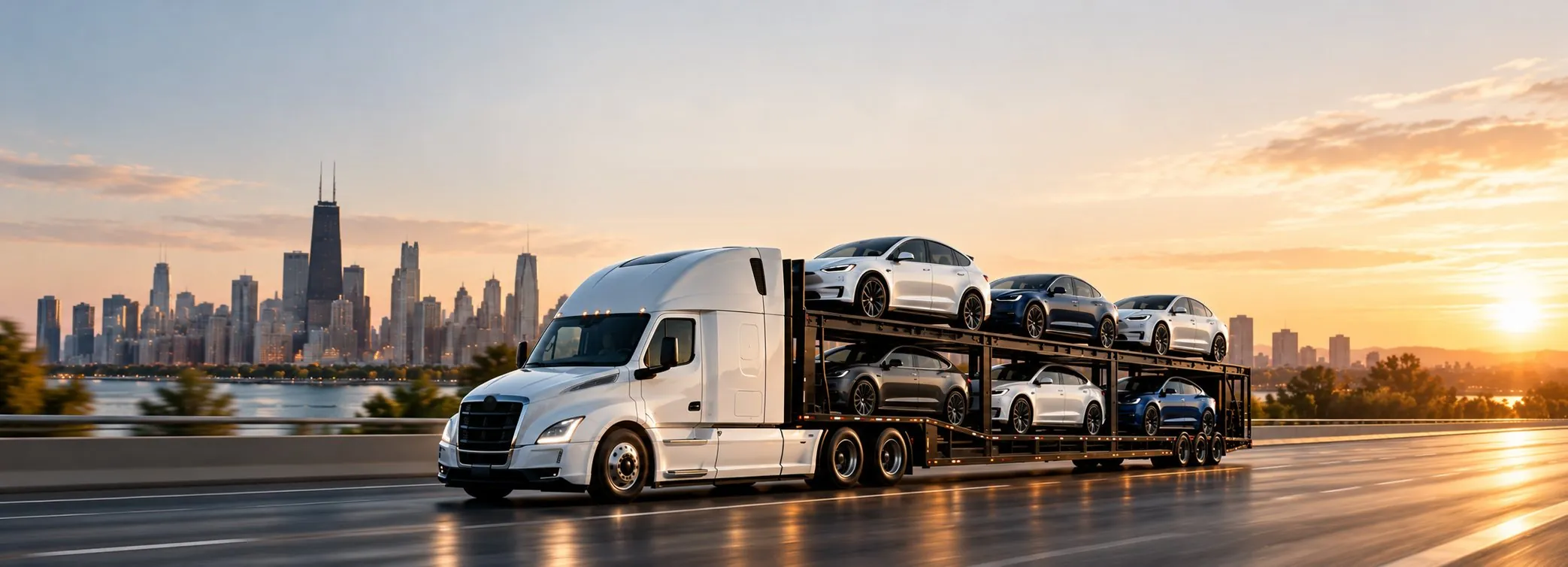
California to Virginia Car Shipping and Auto Transport
The smart choice in car shipping.
Get a California to Virginia Quote
SMART PRICE PROMISE The price we quote is the price you pay, as long as the vehicle, the route, the condition and the shipping details stay the same. See the promise.
Your details stay private Your information stays private: Information you share with Smart Auto Move for the purpose of receiving a quote is used for that purpose only. We do not sell your information.
Prefer to ask AI? Get a quote from Claude, ChatGPT or another AI assistant. See how it works
Written by Richard Avery, President of Smart Auto Move · USDOT 2887232 · MC 969368
How much does it cost to ship a car from California to Virginia?
The cost to ship a car from California to Virginia is typically $1,575 to $2,050 on an open trailer, and takes between 7 to 11 days in transit time. Southern California to Roanoke or the Shenandoah Valley starts at $1,575 to $1,825 over about 2,500 miles. Northern California to Hampton Roads reaches $1,800 to $2,050 over about 2,900. On this lane, where in Virginia your car is going matters more than where in California it starts. The next section shows you why.
Smart Auto Move provides nationwide car shipping throughout the lower 48 states, backed by four strategically located staffed offices, six additional service areas, and a trusted carrier network of more than 16,000 transport professionals nationwide. Our extensive network allows us to serve customers across the continental U.S. with reliable vehicle transport from coast to coast.
Service is not currently available in Alaska, Hawaii, or Puerto Rico.
How much does California to Virginia car shipping cost?
Every row below is a running mid-size car on an open trailer, reviewed September 2026. The lane is priced by region at both ends. On a 2,700-mile run the regions behave differently and the cities inside them do not. The last three rows are there for comparison, and they are the most useful part of the table.
| Route | Also covers | Distance | Days on the road | Open transport |
|---|---|---|---|---|
| Southern California to Roanoke or the Shenandoah Valley BEST VALUE | Blacksburg, Christiansburg, Lexington, Staunton, Harrisonburg, Winchester, Bristol | 2,500 to 2,560 miles | 7 to 9 days | $1,575 to $1,825 |
| Southern California to Richmond | Petersburg, Charlottesville, Williamsburg, Newport News, Hampton | 2,660 to 2,720 miles | 7 to 9 days | $1,600 to $1,850 |
| Southern California to Northern Virginia | Alexandria, Arlington, Fairfax, Loudoun, Prince William, Quantico, Fort Belvoir | 2,670 to 2,730 miles | 7 to 9 days | $1,600 to $1,850 |
| Southern California to Hampton Roads MEASURED | Norfolk, Virginia Beach, Chesapeake, Portsmouth, Suffolk | 2,730 to 2,800 miles | 7 to 10 days | $1,650 to $1,900 |
| Northern California to Richmond, Northern Virginia or the Valley | San Francisco, Oakland, San Jose, Sacramento, Berkeley, Palo Alto | 2,730 to 2,860 miles | 8 to 10 days | $1,750 to $2,000 |
| Northern California to Hampton Roads LONGEST | The Bay Area and Sacramento out to the Virginia coast | 2,860 to 2,920 miles | 8 to 11 days | $1,800 to $2,050 |
| The Central Valley to anywhere in Virginia QUOTED LIVE | Fresno, Bakersfield, Stockton, Modesto, Visalia, Merced | 2,650 to 2,800 miles | 7 to 10 days | Ask us |
| Hampton Roads back to Southern California RETURN LEG | The same road, the other way, already published | About 2,730 miles | 7 to 10 days | $1,850 to $2,050 |
| Los Angeles to Raleigh, North Carolina FOR COMPARISON | A published figure on a shorter run to the same coast | About 2,540 miles | 7 to 9 days | $1,550 to $1,750 |
| Los Angeles to Orlando, Florida FOR COMPARISON | Twelve miles further than Raleigh, and cheaper | About 2,552 miles | 7 to 9 days | $1,425 to $1,575 |
| Any route over 2,500 miles NATIONAL BAND | All of Virginia from all of California | Over 2,500 miles | 7 to 10 days | $1,600 to $2,500 |
Read these as estimates rather than fixed prices. Fuel is the single largest cost in hauling a car and it tracks the market, so the rows get reviewed against it. Road days start when your pickup window closes. A mid-size SUV adds about $150 and a full-size pickup or three-row SUV about $300. Enclosed adds roughly 80 percent. A car that will not start needs a winch truck, which adds $200 or more. See how our national bands work.
Where these figures come from. The Hampton Roads rows, both directions, are already published on our Hampton Roads to Los Angeles page and our Chesapeake page. The Raleigh comparison comes from our Raleigh to Los Angeles page. The Orlando one comes from our California hub. The Richmond, Northern Virginia and Valley rows are set along that same Los Angeles curve, stepped by distance. The Central Valley has no figures behind it, so it is quoted live rather than guessed.
Los Angeles, Long Beach, Anaheim, Santa Ana, Irvine, Riverside, San Bernardino, Ontario, Palm Springs, San Diego and Chula Vista all price as Southern California. San Francisco, Oakland, San Jose, Sacramento, Berkeley, Palo Alto and Santa Rosa price as Northern California.
The fork at Dandridge, Tennessee decides your price
Most of this trip is one road. It is the last few hundred miles that set what you pay. It comes down to a single junction.
A California load runs east on Interstate 40. From Southern California that is Barstow, Flagstaff, Albuquerque, Amarillo, Oklahoma City, Little Rock, Memphis and Nashville. Then, at Dandridge, Tennessee, Interstate 81 begins, right off Interstate 40. That is the fork. Your delivery address decides which way the truck goes.
Interstate 81 runs 855 miles from Dandridge to the Canadian border. Virginia holds the longest stretch of it in any state, about 325 miles. Roanoke, Christiansburg, Lexington, Staunton, Harrisonburg and Winchester all sit on it. A driver turning north is on a corridor he can keep working. That is why the Valley rows are the best-priced in Virginia.
Interstate 64 runs 963 miles from Wentzville, Missouri. It passes Covington, Lexington, Staunton, Charlottesville, Richmond, Newport News, Hampton and Norfolk. Its eastern end is in Chesapeake, Virginia. There is water past it. A driver dropping at the coast has no onward work that way, which is worth about $50 on this lane.
So the order off the truck from California is the Valley first, then Richmond and Northern Virginia, then Hampton Roads. Our Illinois to Virginia page publishes a different order. There the truck enters Virginia from the northwest, so Northern Virginia comes off first. Two pages, two delivery orders, both published.
What to do with this. If your Virginia address is flexible at all, the Interstate 81 corridor is the best-priced place to take delivery. It needs no emissions test either. If you are going to the coast, the price is still good. Just give us the widest pickup window you can.
California to Virginia Car Shipping Questions
The questions customers on this lane really ask, answered with this route’s own numbers.
How much does it cost to ship a car from California to Virginia?
The cost to ship a car from California to Virginia is typically $1,575 to $2,050 on an open trailer, and takes between 7 to 11 days in transit time. Southern California to Roanoke or the Shenandoah Valley starts at $1,575 to $1,825 over about 2,500 miles. Northern California to Hampton Roads reaches $1,800 to $2,050 over about 2,900. The table on this page prices the lane by region at both ends.
Why is the price set by region rather than by city?
Because on a run this long the regions behave very differently, and the cities inside them do not. Southern California prices together, from Los Angeles down to San Diego. Northern California prices as its own group and sits above it. At the Virginia end there are four different answers: the Shenandoah Valley, Richmond, Northern Virginia and Hampton Roads. Grouping by region is more honest than pretending we can separate Anaheim from Long Beach on a 2,700-mile trip.
Which part of Virginia is cheapest to ship to from California?
Roanoke and the Shenandoah Valley, at $1,575 to $1,825. The reason is the road. A California load runs east on Interstate 40 and meets Interstate 81 at Dandridge, Tennessee. Turning north there puts the truck into Virginia almost straight away. It is also a corridor the driver can keep working. Hampton Roads is the far end of the state and the far end of the road.
Why does Hampton Roads cost more than Richmond?
It is about 70 miles further, and it is the end of the line. Interstate 64 runs 963 miles from Missouri. Its eastern terminus is in Chesapeake, Virginia, and there is water past it. A driver dropping in Norfolk or Virginia Beach has no onward work that way, so the last leg is worth a little more to him. It works out at about $50 on this lane.
Does mileage decide the price on a coast-to-coast run?
Less than you would expect, and our own published figures show it. Los Angeles to Orlando is about 2,552 miles at $1,425 to $1,575. Los Angeles to Raleigh is about 2,540 miles at $1,550 to $1,750. Twelve miles apart in distance, about $125 apart in price. Past 2,500 miles the destination’s own market depth sets the rate, not the odometer.
Why does Northern California cost more than Southern California?
Because Southern California is the denser freight market of the two, and it is closer. Los Angeles and San Diego sit on the busiest eastbound corridor in the country. The Bay Area and Sacramento are about 150 miles further from Virginia, with thinner eastbound flow. The gap on this lane runs about $150.
What actually decides my California to Virginia price?
Four things. Which region you start in, since Southern California prices below Northern. Which part of Virginia you deliver to, since the Valley prices below the coast. What the vehicle is: a mid-size SUV adds about $150, a full-size pickup or three-row SUV about $300. And whether you choose open or enclosed. Your quote is one price for the whole trip, worked out for its distance and the route it takes.
How much more is a truck or an SUV?
A mid-size SUV or crossover adds about $150 to the figure in the table. A full-size pickup or a three-row SUV adds about $300. Our Hampton Roads to Los Angeles and Raleigh to Los Angeles pages already publish those steps, and they hold here too. It comes down to deck space and weight.
Are the prices on this page fixed?
They are careful estimates, reviewed against the market. Fuel is the largest single cost in hauling a car, and it moves. So we review these rows against it rather than letting them go stale. Once you accept a quote, the Smart Price Promise holds it. That holds as long as the vehicle, the route, the condition and the shipping details stay the same.
What is included in the price?
Door to door pickup and delivery, loading and unloading, the road miles, and Carrier Cargo Insurance for the whole trip. There is no terminal fee. There is no fuel surcharge added later. Enclosed transport and a vehicle that will not start are priced up front, not at the curb.
How much more is enclosed transport on this lane?
Enclosed costs about 80 percent more than open. On a coast-to-coast run it is worth thinking about harder than on a short one. The car is exposed to weather and road debris for over a week. It is the right call for a classic, a collector car, an exotic, a fresh restoration or anything low to the ground.
What does it cost to ship a car that will not start?
A vehicle that will not start needs a winch truck. That adds $200 or more, depending on what the driver has to do to get it aboard. There is no flat fee. A car that rolls and steers is a very different job from one that does neither. Tell us the true condition when you request a quote and the figure is in your price from the start.
How can I get a lower price on this lane?
Three things help. Give us the widest pickup window you can. A coast-to-coast load is built around several other cars, so flexibility is worth real money. Be flexible on the Virginia end too if you can, since the Valley and Richmond price below the coast. And ask about the military, student and senior discounts before your price is confirmed.
Is it cheaper to ship from California to Virginia or the other way?
From California. Our own two published figures on the same road show it. Southern California to Hampton Roads is $1,650 to $1,900 over about 2,730 miles. Hampton Roads back to Southern California is $1,850 to $2,050 over the same 2,730 miles. About $200 more going west. California is one of the biggest freight origins in the country, so leaving it is the cheaper way round.
Do you offer discounts on this lane?
Yes. Military, student and senior discounts all apply, in either direction. Military is the one most used on this route, because both ends have a heavy service population. Ask before your price is confirmed and it is built into the figure you agree to.
How long does it take to ship a car from California to Virginia?
Between 7 and 11 days on the road. Southern California to the Shenandoah Valley, Richmond or Northern Virginia is 7 to 9 days. Southern California to Hampton Roads is 7 to 10. Northern California is 8 to 10 to the inland cities, and 8 to 11 to the coast. Those are road days. They start when your car is loaded.
When does the transit clock start?
When your car is loaded, not when you book. The pickup window comes first and the road days follow it. That is why the two numbers are quoted separately. Plan around both on a lane this long. The pickup window is where most of the uncertainty sits.
How soon can a carrier pick up in California?
The standard pickup window is 6 days. Expedited narrows it to 3 days, which is 72 hours. California has more trucks looking for eastbound freight than almost anywhere. So a Los Angeles or San Diego pickup is usually placed near the early end of that window.
Can I get a faster pickup?
Yes. Expedited scheduling narrows the pickup window from 6 days to 3, which is 72 hours. The road days stay the same. Federal driving-hour limits apply to every driver on the interstate, and no service moves them. What you are buying is a faster start, not a faster truck.
Why does a 2,700-mile trip take more than a week?
Federal rules cap how long a driver may be behind the wheel each day. There are also eight or nine other cars on the trailer, each with its own pickup and delivery point. The route is built around all of them. A car could be driven coast to coast in four long days. A loaded carrier working legally takes 7 to 10.
Does weather affect this route?
It can add a day, and the route is chosen partly to avoid it. The Interstate 40 corridor through Arizona, New Mexico, Texas and Tennessee is the most weather-reliable eastbound line in the country. It stays open through almost any winter. The variable is the last stretch, where Interstate 81 climbs through the Appalachians and can pick up snow between December and March.
What is the best time of year to ship on this lane?
Spring and fall give you the widest choice of dates. Summer is the busiest stretch, because that is when families and military households move. Winter is quieter, and the Interstate 40 line holds up well. If your dates are flexible, aim for March to May or late September to November.
What route does my car actually take?
East on Interstate 40 for most of the trip. From Southern California that is Barstow, Flagstaff, Albuquerque, Amarillo, Oklahoma City, Little Rock, Memphis and Nashville. Then the road forks at Dandridge, Tennessee, where Interstate 81 begins. North on Interstate 81 for the Valley and Northern Virginia. Onward to Interstate 64 for Richmond and Hampton Roads.
What is special about the fork at Dandridge?
It is where your delivery address starts to matter more than your pickup address. Interstate 81’s southern end is right there at Interstate 40. Virginia holds the longest stretch of it in any state, about 325 miles. A driver turning north is on a corridor he can keep working all the way to New York. A driver carrying on to Hampton Roads is heading for a dead end at the water.
Do Northern California loads take a different road?
Usually Interstate 80 east to begin with, then down to the Interstate 40 line, or across on Interstate 70. The Bay Area and Sacramento are not on the Interstate 40 corridor the way Los Angeles is. That first leg is part of why the northern rows price above the southern ones. Donner Pass in the Sierra Nevada is the one winter variable at that end.
Does Interstate 95 come into it?
Only at the very end, and only for some deliveries. Northern Virginia loads often go up the Valley on Interstate 81 and cut across. That avoids Interstate 95 between Fredericksburg and the Beltway. If your delivery is in Alexandria or Arlington, the Valley routing is usually the faster of the two.
How many states will my car pass through?
Around eight or nine, depending on the exact route. A typical Southern California run crosses Arizona, New Mexico, Texas, Oklahoma, Arkansas, Tennessee and then Virginia. Some clip the Texas panhandle or Kentucky. Every one is inside the lower 48, which is where we operate.
Does my car need an emissions test in Virginia?
Only in Northern Virginia. The counties are Arlington, Fairfax, Loudoun, Prince William and Stafford. The cities are Alexandria, Fairfax, Falls Church, Manassas and Manassas Park. Everywhere else is outside the program. So Richmond, Roanoke, the Shenandoah Valley and all of Hampton Roads need no emissions test at all.
So the cheapest part of Virginia has no emissions test?
That is right, and it is a nice piece of luck. The Shenandoah Valley is the best-priced Virginia destination on this lane, and it is outside the emissions program. Northern Virginia is the one region that needs the test. It is also where the price starts to climb. Cheaper trip, one fewer errand.
Does Virginia require a safety inspection?
Yes, and this one applies everywhere in the state. Virginia runs an annual safety inspection, with a sticker on the windshield. It is a straightforward check at an approved station. Worth booking soon after your car arrives so you are not driving on a California sticker.
How long do I have to register a car in Virginia?
Thirty days. Virginia asks a new resident to title the vehicle and register it at a DMV customer service center within 30 days of moving. Liability insurance has to stay in force, even on a car that is not being driven. Check the current requirements and fees at the Virginia DMV before your car arrives, so the paperwork is ready.
Do I need to do anything about my California registration?
Keep it current until the Virginia paperwork is done, and keep the insurance in force. The California registration should not lapse while the car is on a trailer. Once you have Virginia plates you can close out the California side. The California DMV can tell you what they need.
Will a California emissions car pass in Virginia?
Yes, and in most of Virginia it is not even asked. California emissions equipment meets or exceeds what Virginia looks for. The test only applies in Northern Virginia anyway. A California-spec car is never a problem on this move.
Who usually ships a car from California to Virginia?
Four groups, in rough order. Military and government households, because both ends have a heavy service population. Families relocating for work. People who bought a car online and need it brought home. And students heading to a Virginia campus. All four run busiest from May through August.
Do you handle military moves on this lane?
Yes, and it is the biggest single reason people call us on this route. California has Camp Pendleton, San Diego’s naval complex, Travis, Vandenberg and Fort Irwin. Virginia has Naval Station Norfolk, Oceana, Little Creek, Langley, Quantico, Fort Belvoir and the Pentagon. Orders move cars across this lane both ways all year. The military discount applies.
Can you ship a car I bought online in California?
Yes, and it is one of the most common jobs we do on this lane. California has the deepest used and collector market in the country, so a lot of Virginia buyers shop there. We collect from a dealer, an auction, a private seller or a storage lot. Then we deliver to your Virginia address.
Can you ship a collector car from California to Virginia?
Yes, and enclosed transport is what we recommend for one. California is where a great many collector cars live, and this is a long trip. Enclosed costs about 80 percent above the open figure. It keeps the car away from weather and road debris for the whole 2,700 miles.
Can you ship two cars at once?
Yes, and on a move this long it is usually the better deal. Both cars go on the same carrier and arrive together. That is what most relocating households want. Tell us both vehicles when you request the quote, and the price covers the pair.
Can you ship an electric vehicle on this lane?
Yes. An EV ships like any other car on an open or enclosed trailer, and the battery does not need charging on the way. Tell us the model when you book. Some EVs are heavier than a comparable gas car, and that affects where the driver places it on the deck. Leave it at a moderate state of charge rather than full.
Is my vehicle insured during transport?
Yes. Your car travels under the assigned carrier’s Carrier Cargo Insurance. Cover starts the moment it is loaded and ends when it is handed back to you. It goes from your address straight onto the trailer. No terminal, no holding lot, no gap in between. You can check any carrier’s active authority and insurance on the FMCSA SAFER system before your car is loaded. We will tell you who the carrier is.
Is my car stored anywhere on a trip this long?
No. It stays on the same carrier from pickup to delivery, and is covered the whole way. There is no terminal and no holding lot in the middle. On a 2,700-mile run that is worth knowing. One trailer, one driver, one handover at each end.
Do I have to be there for pickup and delivery?
Someone does, at both ends. The driver walks the car with you and records its condition on the Bill of Lading, and you both sign. It takes a few minutes, and it is what protects you on a long trip. Better to be there than to leave the keys.
Can someone else release or receive the car?
Yes. Any adult you nominate can hand the car over or take delivery, as long as we have their name and number at booking. On a coast-to-coast move that is very common, because people often fly ahead of the car. A family member, a friend or a building manager all work fine.
Is door to door available on this lane?
Yes, at both ends, wherever a full-size carrier can work safely and legally. A carrier is about 75 feet long. Where a street is too narrow, a gate too tight or a branch too low, we agree a meet-point a few minutes away. It costs nothing extra, and the paperwork and inspection are exactly the same.
Can I leave personal items in the car?
Usually yes, within reason. Keep it light and keep it low. Use the trunk or the footwells rather than the seats or the parcel shelf, so the driver can see out and the weight stays sensible. Take anything valuable or irreplaceable with you. Tell us at booking if you are packing more than a suitcase or two. The assigned carrier will then be expecting it.
Should I take my toll transponder off?
Yes. A FasTrak from California will read at gantries on the way. So will an E-ZPass once the car is in Virginia. Take it off the windshield, or seal it in its shielded bag, before the driver arrives. This trip passes tolled roads at both ends, so it is worth two minutes.
How much fuel should be in the tank?
About a quarter of a tank is ideal. That is enough to load, unload and drive away at the far end. It also avoids weight the trailer does not need. A full tank on nine cars adds up fast over 2,700 miles.
Should I wash the car before pickup?
It helps, and on a long trip it helps more. A clean car makes the condition report at pickup much easier to read. That makes the inspection at delivery easier too. Photograph it in daylight from all four corners once it is clean, and you have your own record alongside the Bill of Lading.
What is a Bill of Lading?
It is the condition report for your car, and the most useful piece of paper in the whole trip. The driver records the car’s condition at pickup and you both sign. At delivery you compare the car against it before signing again. Keep your copy until the delivery is complete and you are satisfied.
What happens if something is damaged in transit?
Note it on the Bill of Lading at delivery, before you sign, and photograph it. That is the record that matters. Then call us. We handle the claim with the carrier from there rather than leaving it with you. It is rare, and it is why the two inspections are worth the few minutes they take.
Do you ship SUVs, pickups and vans?
Yes, every week on this lane. A mid-size SUV or crossover adds about $150 to the table figure. A full-size pickup or a three-row SUV adds about $300. Minivans and work vans ship on open trailers too. Oversized lifted trucks and dual-rear-wheel pickups get their own quote.
Can you ship a lowered or modified car?
Yes, and tell us about it when you book. Low ground clearance, a front splitter, a wide body or oversized wheels all change which trailer and ramps the job needs. Given the details up front, we assign a carrier equipped for it. For anything very low that is usually enclosed transport with a lift gate.
How do I track the car across the country?
Call us and we will tell you where it is. On a 2,700-mile run we stay in contact with the driver and pass on what matters. That includes anything that changes the delivery day. The driver also calls you directly as he gets close, to agree the handover point.
Do you have offices at either end of this lane?
Yes at the California end. Our Los Angeles office is at 5111 Harold Way Suite 301, on 213-766-0064. It is one of four staffed Smart Auto Move offices. At the Virginia end, Portsmouth is one of our six service areas, covering Hampton Roads. Shipments there are arranged on the national line at 888-709-9078.
Where are your other offices?
Chicago at 742 E 87th Pl, Lakewood in Washington at 5607 Boston Ave SW, and Kissimmee in Florida at 2095 E Irlo Bronson Memorial Hwy. With Los Angeles that is four staffed offices. There are also six service areas, including Portsmouth in Virginia.
Who actually moves my car?
Smart Auto Move is a car shipping company. We arrange and manage your transport end to end. The job goes to a vetted carrier from a network of more than 16,000 transport professionals nationwide. We stay with it until the car is delivered. You will know which carrier has your car, and you can check their authority and insurance yourself before it is loaded.
How do I check that you are properly authorized?
Look us up on the FMCSA SAFER system under USDOT 2887232 and MC 969368. Both numbers are on every page of this site for exactly that reason. We are also BBB A plus accredited. We will give you the assigned carrier’s USDOT number so you can check them too.
Will you call or text me after I request a quote?
No. We do not call or text quote-form leads. Your quote comes back to you, and the next move is yours. If you would rather talk it through, call 888-709-9078 or the Los Angeles office on 213-766-0064 and we will quote you on the phone.
Do you sell my information?
No. Information you share with Smart Auto Move for the purpose of receiving a quote is used for that purpose only. We do not sell your information. That is why the quote form on this page does not turn into a week of calls from companies you have never heard of.
Where does Smart Auto Move ship?
Smart Auto Move provides nationwide car shipping throughout the lower 48 states, backed by four strategically located staffed offices, six additional service areas, and a trusted carrier network of more than 16,000 transport professionals nationwide. Service is not currently available in Alaska, Hawaii, or Puerto Rico.
How do I book this shipment?
Start with the quote form on this page, or call 888-709-9078. We need both ZIP codes, plus the year, make and model. Then whether the car runs, your first available date, and open or enclosed. You will have a price to look at, and nothing is booked until you say so.
Past 2,500 miles, mileage stops predicting the price
This is the part of coast-to-coast pricing that surprises people, and our own published figures show it plainly.
Los Angeles to Orlando is about 2,552 miles at $1,425 to $1,575. Los Angeles to Raleigh is about 2,540 miles at $1,550 to $1,750. Almost the same trip. Florida is the cheaper one. It is one of the deepest two-way markets in the country, and cars move both directions all year.
Los Angeles to Miami is about 2,736 miles. Los Angeles to Hampton Roads is about 2,730. Miami is the cheaper of the two, despite being marginally further. The difference is market depth at the far end, not the road.
Past about 2,500 miles, what sets your rate is how much freight moves in and out of the place your car is going. Virginia is a solid market rather than a huge one. So this lane prices a little above the Florida runs, and a little below the thinner Mountain West destinations. That is the honest picture, and it is why the table is grouped the way it is.
It also explains the direction. Southern California to Hampton Roads is $1,650 to $1,900. Hampton Roads back to Southern California is $1,850 to $2,050, on the same 2,730 miles. About $200 more going west. California is one of the biggest freight origins in the country, so leaving it is the cheaper direction. You are on the cheaper side of this road.
What the vehicle changes, and what it does not
Mid-size car
Accord, Camry, Malibu, 3 Series and similar. Every figure in the table is for one of these on an open trailer.
Mid-size SUV or crossover
RAV4, CR-V, Equinox, Highlander and similar. Add about $150 to the table figure. It is deck space and weight, nothing more.
Full-size pickup or three-row SUV
F-150, Silverado, Tahoe, Suburban and similar. Add about $300 to the table figure.
Electric vehicles
They ship exactly like any other car and need no charging on the way. Tell us the model. Some are heavier than a comparable gas car, and that affects where the driver places them on the deck.
Lowered or modified
Low clearance, a splitter, a wide body or oversized wheels change which trailer and ramps the job needs. Given the details up front, we assign a carrier equipped for it.
Not running
A winch truck adds $200 or more, depending on what the driver has to do to load it. No flat fee, and the figure is in your quote from the start.
Open or enclosed on a 2,700-mile run
This decision is worth more thought on a coast-to-coast lane than on a short one. The car is out in the open for over a week rather than a day or two.
Open transport
What nine out of ten customers pick, and the basis for every figure in the table. The right choice for an everyday car, SUV or pickup. Best value on any route, and the trailers run this corridor constantly.
Enclosed transport
About 80 percent above open. The right call for a classic, a collector car, an exotic, a fresh restoration or anything low to the ground. California is where a great many collector cars live. We book plenty of these eastbound.
Expedited pickup
Narrows the pickup window from 6 days to 3, which is 72 hours. The road days stay the same, because federal driving-hour limits apply to every truck on the interstate. A faster start, not a faster truck.
Standard scheduling
A 6-day pickup window, and the best value on the lane. On a route this long, a wider window is worth real money. It gives us far more chances to place your car on a trailer that is already heading east.
Good news on Virginia paperwork, and it favors the cheap end
Virginia is straightforward. The best-priced part of the state is also the easiest part on paperwork.
Emissions testing is Northern Virginia only
Virginia tests in the counties of Arlington, Fairfax, Loudoun, Prince William and Stafford. It also tests in the cities of Alexandria, Fairfax, Falls Church, Manassas and Manassas Park. That is it. Richmond, Roanoke, the Shenandoah Valley and all of Hampton Roads are outside the program. They need no emissions test at all. Virginia DEQ
The cheap end is also the easy end
The Interstate 81 corridor is the best-priced Virginia destination on this lane. It is also outside the emissions program. Northern Virginia is the one region that needs the test, and it is where the price starts to climb. Cheaper trip, one fewer errand.
Book the safety inspection
Virginia runs an annual safety inspection, with a sticker on the windshield, and this one applies statewide. It is a straightforward check at an approved station. Worth booking soon after your car arrives so you are not driving on a California sticker.
Thirty days to register
Virginia asks a new resident to title the vehicle and register it at a DMV customer service center within 30 days of moving. Liability insurance has to stay in force, even on a car that is not being driven. Keep the California registration current until the Virginia side is done. Virginia DMV
Who ships cars from California to Virginia
Military and government
The biggest group on this lane, and it runs both ways. California has Camp Pendleton, the San Diego naval complex, Travis, Vandenberg and Fort Irwin. Virginia has Naval Station Norfolk, Oceana, Little Creek, Langley, Quantico, Fort Belvoir and the Pentagon. Orders move cars on this road all year. Military discount.
Relocating families
A coast-to-coast move with two cars and one driver means two trips or a tow. We load both on the same carrier and deliver them together. That is the single most common reason people call us on this route.
Online buyers
California has the deepest used and collector market in the country. So a lot of Virginia buyers end up shopping there. We collect from a dealer, an auction, a private seller or a storage lot.
Collectors
Enclosed transport eastbound out of California is a steady part of our work. Over 2,700 miles, keeping a car away from weather and road debris is worth the 80 percent.
Students
Virginia Tech in Blacksburg and James Madison in Harrisonburg both sit on the Interstate 81 corridor. That is the best-priced part of the lane. Also UVA, William and Mary, VCU, George Mason and Old Dominion. Student discount.
Dealers and auctions
Westbound and eastbound, on their own terms and timelines. Dealer shipping and auction pickups.
How California to Virginia car shipping works
Get your price
We need both ZIP codes. Then the year, make and model, whether the car runs, your first available date, and open or enclosed. Use the form on this page, or call the Los Angeles office.
Confirm the booking
Review the route, the transport type, the timing and the access at both ends. Then your price. The Smart Price Promise holds it from the moment you accept.
We assign a carrier
Your job goes to a vetted carrier, from a network of more than 16,000 transport professionals nationwide. We tell you who it is. You can check their authority and insurance yourself.
Pickup in California
Standard pickup window is 6 days, expedited is 3 days, which is 72 hours. The driver walks the car with you and records its condition on the Bill of Lading. Then he loads.
Across the country
7 to 11 days, depending on the regions at each end. Interstate 40 most of the way, then the fork at Dandridge. Call any time and we will tell you where your car is.
Delivery in Virginia
The driver calls as he approaches and agrees a safe, legal handover point. Compare the car against the pickup report. Note anything before you sign, and it is yours.
The carrier behind your shipment
Smart Auto Move is a car shipping company. We arrange and manage your transport end to end. The truck itself belongs to a vetted carrier, from a network of more than 16,000 transport professionals nationwide.
You will know who has your car
We give you the assigned carrier’s name and USDOT number. Look them up on the FMCSA SAFER system and you can see their active authority and insurance before your car is loaded. Look us up too, under USDOT 2887232 and MC 969368.
Carrier Cargo Insurance, the whole way
Your car travels under the assigned carrier’s Carrier Cargo Insurance. Cover starts the moment it is loaded and ends when it is handed back. No terminal, no holding lot, no gap in between. That holds across all 2,700 miles.
Smart Auto Move Inc
Los Angeles office: 5111 Harold Way Suite 301, Los Angeles, CA 90027 · 213-766-0064
Portsmouth, Virginia is our Hampton Roads service area, covering Norfolk, Virginia Beach, Chesapeake and Suffolk.
National line: 888-709-9078
USDOT 2887232 · MC 969368
Registered business address: 4208 Six Forks Rd Ste 1000, Raleigh, NC 27609.
Our four staffed offices
Los Angeles, CA · 5111 Harold Way Suite 301 · 213-766-0064
Chicago, IL · 742 E 87th Pl · 312-300-7773
Lakewood, WA · 5607 Boston Ave SW · 253-200-5645
Kissimmee, FL · 2095 E Irlo Bronson Memorial Hwy · 407-377-6073
A staffed office at the California end
Los Angeles is one of our four staffed offices, so the team booking your carrier is at the pickup end of this lane. At the Virginia end, Portsmouth is one of our six service areas. Shipments there are arranged on the national line.
Your car is never stored anywhere. It goes from your address straight onto the carrier and stays covered under Carrier Cargo Insurance for the whole trip. One trailer, one driver, and a handover at each end.
What our customers say




Crystal Evans was very helpful.

More California and Virginia car shipping pages
Ready to ship your car from California to Virginia?
Start with both ZIP codes, the vehicle details and your first available date. Or call the Los Angeles office and we will price it with you on the phone.