
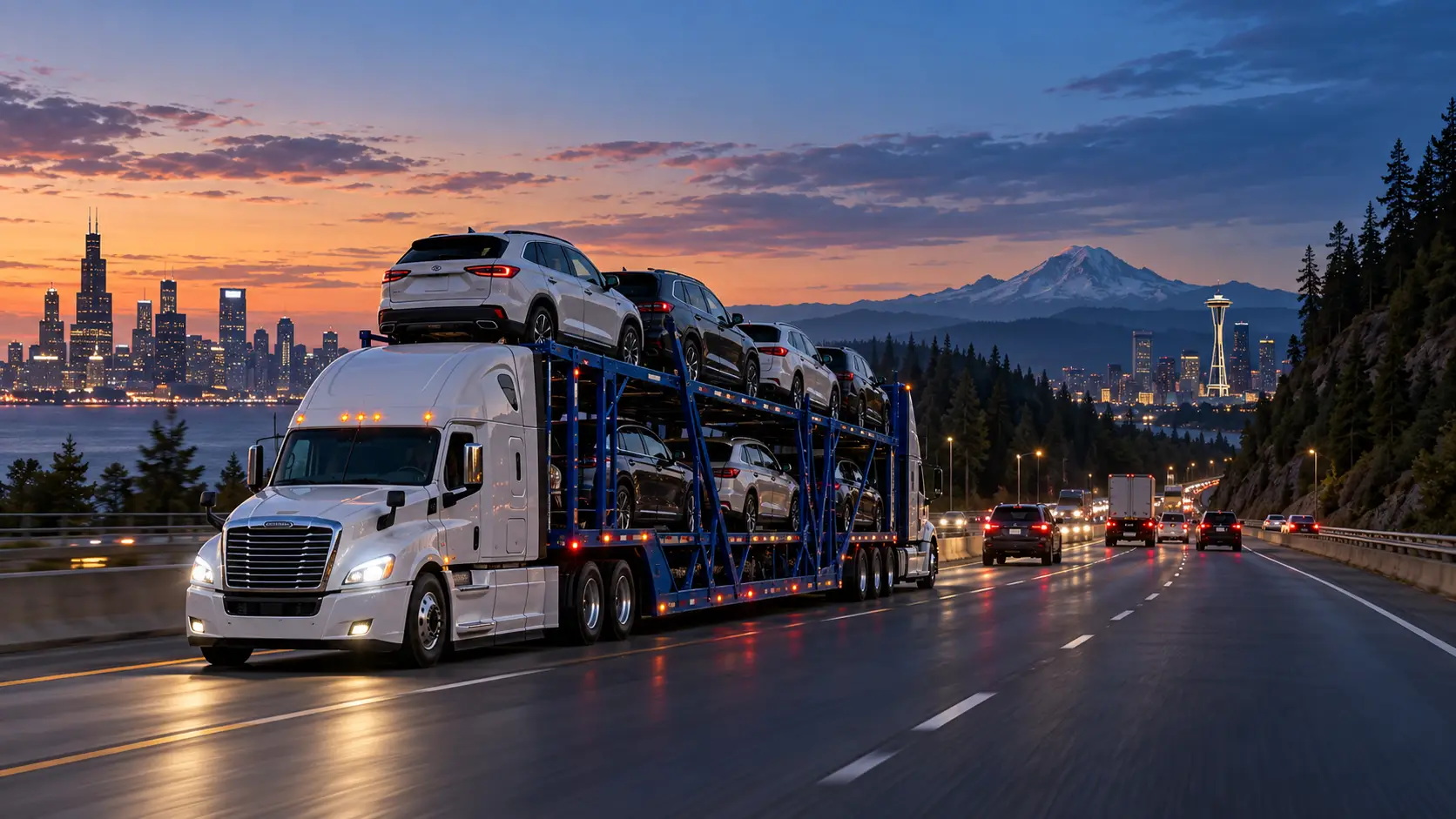
Illinois to Washington Car Shipping
Written by Richard Avery, President of Smart Auto Move · USDOT 2887232 · MC 969368
The cost to ship a car from Illinois to Washington is typically $1,050 to Spokane and up to $1,525 to Everett, on an open trailer, and takes between four to seven days in transit time. This is the one route where we have a staffed office at each end, Chicago at the start and Lakewood at the finish. The other thing worth knowing is that the whole trip runs on a single interstate.
Illinois to Washington Car Shipping Prices
Six Illinois car shipping routes into Washington that we price regularly, with real numbers. Mid-size sedan, open trailer, reviewed September 2026. Sorted by price, and on this lane that is almost entirely a question of how deep into Washington you are going.
| Route | Distance | Days on the road | Open transport |
|---|---|---|---|
| Rockford, IL to Spokane, WA BEST VALUE | 1,715 miles | 4 to 6 days | $1,050 to $1,250 |
| Chicago, IL to Spokane, WA | 1,785 miles | 4 to 6 days | $1,100 to $1,300 |
| Rockford, IL to Seattle, WA | 1,995 miles | 5 to 7 days | $1,200 to $1,400 |
| Chicago, IL to Seattle, WA BUSIEST LANE | 2,065 miles | 5 to 7 days | $1,250 to $1,450 |
| Chicago, IL to Lakewood, WA OFFICE TO OFFICE | 2,105 miles | 5 to 7 days | $1,275 to $1,475 |
| Springfield, IL to Everett, WA | 2,165 miles | 6 to 8 days | $1,325 to $1,525 |
Operable mid-size sedan on an open trailer. Oversized vehicles, non-runners and enclosed shipments each price on their own footing, as does a January delivery into Puget Sound. Tell us the pickup town, the delivery town and the vehicle, and we will put a current figure against the exact run.
The top row and the bottom row are $475 apart, and it is all geography. Spokane sits just inside the Washington line; Everett is 30 miles past Seattle at the far end. Those two cities are 450 miles apart, which is most of the spread on this table. Tell us the actual delivery town rather than "Washington" and the number gets a lot more useful.
The road to Chicago to Seattle Car Shipping
Most long routes hand a car between three or four interstates. This one barely does.
I-90 begins in Chicago and ends in Seattle. Your car leaves Illinois on it, crosses Wisconsin, Minnesota, South Dakota, Montana and Idaho on it, enters Washington at Spokane on it, and comes over the Cascades into Seattle on it. Roughly 2,000 miles, one interstate.
That matters more than it sounds. A single-corridor route concentrates carrier traffic instead of scattering it, so there are more trucks running your exact direction on any given day. It is a large part of why the pickup windows on this lane behave and why the transit estimate is five to seven days rather than a shrug.
It also makes the trip easy to picture. Your car is on the same road the whole way, and the driver's schedule is set by how many hours federal rules let him drive each day rather than by hunting for a connection. Ask him where he is and the answer is a mile marker on I-90.
Illinois Vehicle Shipping: the north of the state wins this one
On our Illinois to Texas lane, downstate has the head start. Here it is the other way round, and the reason is simply where I-90 goes.
The interstate leaves Chicago heading northwest, straight through Rockford, before it turns west for good. A car picked up in Rockford is already 70 miles into the trip. Springfield and Peoria, which do so well on the Texas run, sit southwest of the city and have to come back up to the line first. That is the whole of Illinois auto transport pricing on this lane in one paragraph.
Rockford and northern Illinois
Sitting on I-90 with a genuine head start, and it shows in the table twice: Rockford beats Chicago to both Spokane and Seattle. Belvidere, Elgin and Huntley are on the same stretch.
Chicago, Aurora and Naperville
The volume end of the lane, with more westbound trucks than anywhere else in the state and a staffed Smart Auto Move office in the city. This is where the pickup windows fill fastest.
Peoria, Springfield and downstate
A little further round, so they price slightly above the northern pickups. Still straightforward, and still statewide, just not the shortcut they are on a Texas-bound run.
One Illinois note for pickup day: take the I-PASS off the windshield before the driver arrives. A car riding through the tollway on a trailer can still read as a passing vehicle, and it is a two-second job. If you are in the city, expect the handover a few minutes away in a shopping plaza rather than on a permit-parking block; we agree the spot while your order is being scheduled.
Winter on I-90, and how to plan around it
Between about November and March this route has two places worth knowing about, and both are manageable if you build in a little slack.
The practical effect of all this is about one extra day on a bad week, not a lost shipment. Nobody runs a closed pass and nobody should. Book a week earlier than you otherwise would for a December through February delivery into Seattle, and the schedule looks after itself.
Winter is also the one time enclosed transport makes sense for an ordinary car. The upper Midwest salts heavily from December through March, and your car sits on an open trailer through all of it. An enclosed trailer keeps the salt off the paint and off the underside entirely. That is a real argument, separate from the usual one about what the car is worth.
Offices at both ends of this route
This is the only lane in our network with a staffed office at each end. Chicago handles the Illinois side, Lakewood handles the Washington side, and each has its own local number.
Chicago, Illinois
742 E 87th Pl, Chicago, IL 60619
Local: 312-300-7773
Hours: Monday to Thursday 8:00 to 20:00, Friday 8:00 to 18:00, Saturday 10:00 to 15:00, closed Sunday.
Handles pickup coordination across Chicago, Cook County, Rockford, Aurora, Naperville and the rest of the state.
Lakewood, Washington
5607 Boston Ave SW, Lakewood, WA 98499
Local: 253-200-5645
Hours: please call to confirm the current schedule before visiting.
Handles delivery coordination across Lakewood, Tacoma, Seattle, Bellevue, Everett and the wider Puget Sound region.
What that gets you in practice is a straight answer to whichever question you actually have. Access on a Chicago side street is a Chicago question. Whether a hauler can get up your street in West Seattle is a Lakewood question. Neither goes to somebody guessing from two thousand miles away.
How Illinois to Washington Auto Transport Works, Step by Step
Six steps from quote to keys. Knowing the order takes most of the guesswork out of a long move.
Tell us the two addresses
Your pickup point in Illinois, your delivery point in Washington, the year make and model, whether it runs, and the first day you could hand it over.
We price it and you confirm
Nothing is booked until you have the route, the service level, the collection window and the number in front of you. Once you say go, the Smart Price Promise stands behind that number for the shipment as described.
We match a carrier
We look for a truck already committed to the I-90 run rather than one making a special trip. Out of northern Illinois there are usually several to choose between.
Pickup day in Illinois
Condition report first: the driver notes every mark on the Bill of Lading and you both sign off on it. Walk round with your phone beforehand so there is a dated set of pictures that belongs to you.
The run west
Four to seven days, all of it on one road. Email updates from us, GPS on the trucks that carry it, and the driver's number in your phone for the days you would rather just ask a person.
Delivery in Washington
Same inspection in reverse: compare the car to the Bill of Lading from pickup day, settle the balance with the driver, collect your keys and your paperwork.
Washington Car Shipping: What to Know About Delivery
Washington splits into two very different halves for a car hauler, and the Cascades are the line.
Spokane and the east
Flat, open and right on the interstate. Eastern Washington deliveries are among the easiest on the whole route, and they are the first stop after the state line.
Seattle and Bellevue
Hill streets, narrow residential blocks and restricted parking, especially in Queen Anne, Capitol Hill and West Seattle. A nearby lot solves most of it in ten minutes, arranged before the truck arrives.
Tacoma, Lakewood and Everett
More room than Seattle proper and straightforward in most neighborhoods. Our Lakewood office covers this whole stretch and knows which streets are worth avoiding.
Mind the two hour time difference when you give us contact numbers. A driver finishing in Washington at four in the afternoon is calling at six o'clock Illinois time. Give us the number of whoever is actually in Washington to receive the car, not the number of whoever booked it from Chicago, and that call lands where it should.
Open, Enclosed and Expedited Washington Vehicle Shipping
Three ways to move the same car. Here is the plain version of each.
Open transport
What every figure on this page assumes, and the right call for a normal car. Nine or ten vehicles to a double-deck trailer, open to the air, which is how the manufacturers themselves move stock. Nothing else comes close for availability on I-90.
Enclosed transport
Plan on about 80 percent more than open. A $1,000 open move is roughly $1,800 enclosed. The arithmetic is simple: a hard-sided trailer takes two to six cars where an open deck takes ten, so the trip is split fewer ways. Right for a classic, an exotic, fresh paint, a car that will not clear a ramp, or any car crossing the salt belt in February.
Expedited pickup
Six days of collection window becomes three. What it moves is the start of the trip, not the length of it. Two thousand miles takes what it takes, and federal driving hours set that, not the service level.
Why ship your vehicle instead of driving it?
Chicago to Seattle is about 30 hours behind the wheel, so four days at a sensible pace. Plenty of people genuinely want that drive across Montana, and if you are one of them, go and enjoy it. If you are not, here is the case for putting the car on a truck.
Top 5 Reasons to ship your vehicle from Illinois to Washington instead of driving
- Skip the hard driving days. Long trips across several states bring weather, traffic and roads you do not know. Hand those miles to a driver who runs them every week.
- Rentals add up fast. A rental while you are away costs real money, comes with rules, and never feels like your own car.
- Get there sooner. Driving coast to coast eats days. Fly, land, and meet your car at the other end.
- Keep your travel money. Gas, motels, meals, tolls and the odd repair add up to more than most people expect.
- Enjoy the trip you planned. Storms, closures and a check-engine light can turn a drive into a three-day delay.
The winter version of that last point is the one to take seriously. Four days across the northern tier in January is a different trip from four days in June. A professional driver crosses those passes every week and knows when to wait; most people making the drive once do not.
What our customers say
Reviews from across our offices, including Chicago and Lakewood. You can also read the customer reviews on our BBB profile, where we hold an A+ rating and have been accredited since 2016.




Crystal Evans was very helpful.

Illinois to Washington Car Shipping Questions
The questions we get asked most on this lane, answered with this route's own numbers rather than national averages.
How much does it cost to ship a car from Illinois to Washington?
The cost to ship a car from Illinois to Washington is typically $1,050 to $1,525 on an open trailer, depending on your two cities. Six routes with real numbers: $1,050 to $1,250 Rockford to Spokane, $1,100 to $1,300 Chicago to Spokane, $1,200 to $1,400 Rockford to Seattle, $1,250 to $1,450 Chicago to Seattle, $1,275 to $1,475 Chicago to Lakewood, and $1,325 to $1,525 Springfield to Everett. Mid-size sedan, reviewed September 2026.
How long does Illinois to Washington auto transport take?
Four to six days to Spokane and five to seven to the Puget Sound cities. Count those from the moment the car is loaded, not from the day you book. Federal hours-of-service rules cap how far a driver can legally go in a day, which is what sets the floor on a run this long.
Why is Spokane so much cheaper than Seattle?
Because it is 280 miles closer, and those are the last 280 miles of the trip. Spokane sits just inside the Washington line on I-90 while Seattle is at the far end, past the Cascades. If your final destination is in eastern Washington, that gap is real money and the table shows it plainly.
Is Rockford really closer to Seattle than Chicago?
Yes, by about 70 miles, and it is one of the few places that is true. I-90 leaves Chicago heading northwest and goes straight through Rockford, so a Rockford pickup is already on the road. This is the opposite of our Illinois to Texas lane, where downstate has the head start. The road decides, not the map.
What road does my car actually take?
I-90, almost the whole way. It begins in Chicago and ends in Seattle, running through Wisconsin, Minnesota, South Dakota, Montana and Idaho before crossing into Washington at Spokane. About 2,000 miles on one interstate, which is unusual and part of why scheduling on this lane is steadier than you might expect.
Does winter change anything?
It can, between about November and March, and it is worth planning around rather than worrying about. The Montana stretch of I-90 and Snoqualmie Pass, the last climb into Seattle, both take chain controls and short closures. A pass reopens in hours rather than days, so the practical effect is usually one extra day. Book a week earlier for a January delivery and it takes care of itself.
What affects the price on this lane?
How deep into Washington you are going, first. Spokane, Seattle and Everett span 450 miles end to end, and that spread is most of the difference between the top and bottom of the table. Vehicle size comes next, then the month, then how tightly you need the collection date pinned. Loosening that date is the lever you actually hold.
What is a pickup window?
It is the spread of days inside which your car will be collected, counted forward from the date you name. Six days on standard, three on expedited. Chicago is the busiest freight crossroads in the country, so westbound windows out of northern Illinois tend to fill early rather than late.
Should I ship open or enclosed?
Open, for a daily driver, and every figure on this page is an open trailer. Plan on about 80 percent more than open for enclosed. A $1,000 open move is roughly $1,800 enclosed. A hard-sided trailer holds two to six cars where an open one holds ten, so each car carries more of the cost. Worth it for a classic, an exotic, fresh paint, or a car too low to clear a ramp.
Does enclosed make more sense in winter on this route?
For some people, yes, and it is the one seasonal argument for enclosed that is not about the car's value. The upper Midwest salts heavily from December through March, and an enclosed trailer keeps all of it off the paintwork and the underside. If your car has fresh paint or you are precious about the undercarriage, a winter shipment is the time to think about it.
Is my car insured during transport?
Yes. Carrier Cargo Insurance, held by the carrier hauling it, covers the vehicle for all 2,000 miles. That carrier's certificate lands with us the moment your order is assigned to a truck, and we will forward it on request. If a relocation package or an employer needs it in writing before the truck arrives, just say so.
Can I leave personal items in the car?
Usually yes, within reason. Most drivers will take a few things as a courtesy. Keep it under about 100 pounds, pack it neatly, and keep it out of sight from outside the car. Think a few boxes in the trunk rather than a carload. The one thing to know is that you are paying to move the vehicle, so the carrier's insurance covers the car itself. Keep anything you would hate to lose with you.
Is door to door really door to door?
Yes, wherever a 75-foot rig can get in and out safely and within the law. Where it cannot, the handover shifts to a wider spot minutes away rather than becoming your problem. On this lane it is Seattle's hill streets and Chicago's permit blocks that come up, and both get settled while the order is being scheduled.
How do I prepare the car?
Give it a wash, so the driver can actually see what he is writing down. Burn the tank down to a quarter or so. Tuck the mirrors, strip the roof bars, clear the cabin. He needs one key and nothing else. Your own photos, taken before he pulls up, are worth the two minutes. Say at booking if it sits low or has been modified. Pull the I-PASS off the windshield too, and pick up a Good To Go pass once you are settled in Washington.
How far ahead should I book, and how does payment work?
Two to three weeks is comfortable, and a little more between December and February. A deposit is due when you book and the balance is paid to the driver at delivery, usually by cashier's check, money order or cash. You can also put the whole amount on a credit card at booking.
Can I cancel?
Cancel any time before we assign a carrier and your deposit comes back to you. Once we assign one and send you the driver's details, that money is spoken for. It is not gone, though. You can push the move back and use it on a later shipment.
How do I know a car shipping company is legitimate?
Two checks and you are most of the way there. First the credentials: look up USDOT 2887232 and MC 969368 on FMCSA SAFER, free, takes a minute, and see the A+ accreditation on our BBB listing. Second the pricing: get several quotes and watch for the one sitting way under the rest. That is the one to interrogate, not the one to grab. And do not be put off by a deposit. Firms that ask for nothing tend to be the ones least sure they can deliver the number.
Can I track my car?
You get GPS tracking when the carrier and truck support it, the driver's phone number for a call or text along the way, and email updates from us. We say it that plainly because no one booking your shipment controls whether a given truck carries a tracking system.
Can you ship a car that does not run?
Yes, provided the wheels turn, the steering works and the brakes hold, and provided the trailer has a winch on it. No set surcharge, but budget $200 upward of the running price. Flag it when you ask for the quote so we send a winch truck instead of discovering the problem on the driveway.
Do I need to be there at both ends?
A person has to be at each end for the paperwork and the key, but it need not be you. A partner, a parent, a neighbor, a colleague, anyone sensible over 18. Name the Illinois person and the Washington person when you book, with a phone number for each, and the driver calls whoever is actually standing there. Remember the two hour time difference when you give us those numbers.
Do you have offices at both ends of this route?
Yes, and this is one of the few lanes where that is true. Our Chicago office at 742 E 87th Pl handles the Illinois end, and our Lakewood office at 5607 Boston Ave SW handles the Washington end. Both are staffed Smart Auto Move locations with their own local numbers, so origin questions and delivery questions go to people who know the ground.
Do you pick up outside Chicago?
Yes, statewide. Rockford, Aurora, Naperville, Elgin, Joliet, Peoria, Springfield, Bloomington, Champaign, Rock Island and the towns in between. Anywhere along the I-90 line north and west of the city is particularly well served on this route.
Where in Washington can you deliver?
Anywhere in the state. Washington vehicle shipping covers Seattle, Tacoma, Lakewood, Bellevue, Everett, Spokane, Olympia, Vancouver, Bellingham, Yakima, Kennewick and the smaller places around them. The Puget Sound region is covered by our own Lakewood office. The Olympic Peninsula and the San Juan Islands need extra lead time and we will tell you honestly how much when you ask.
Illinois and Washington Car Shipping Pages and Guides
The Illinois vehicle shipping and Washington vehicle shipping pages on either end of this route, plus the guides worth a look before you book.