
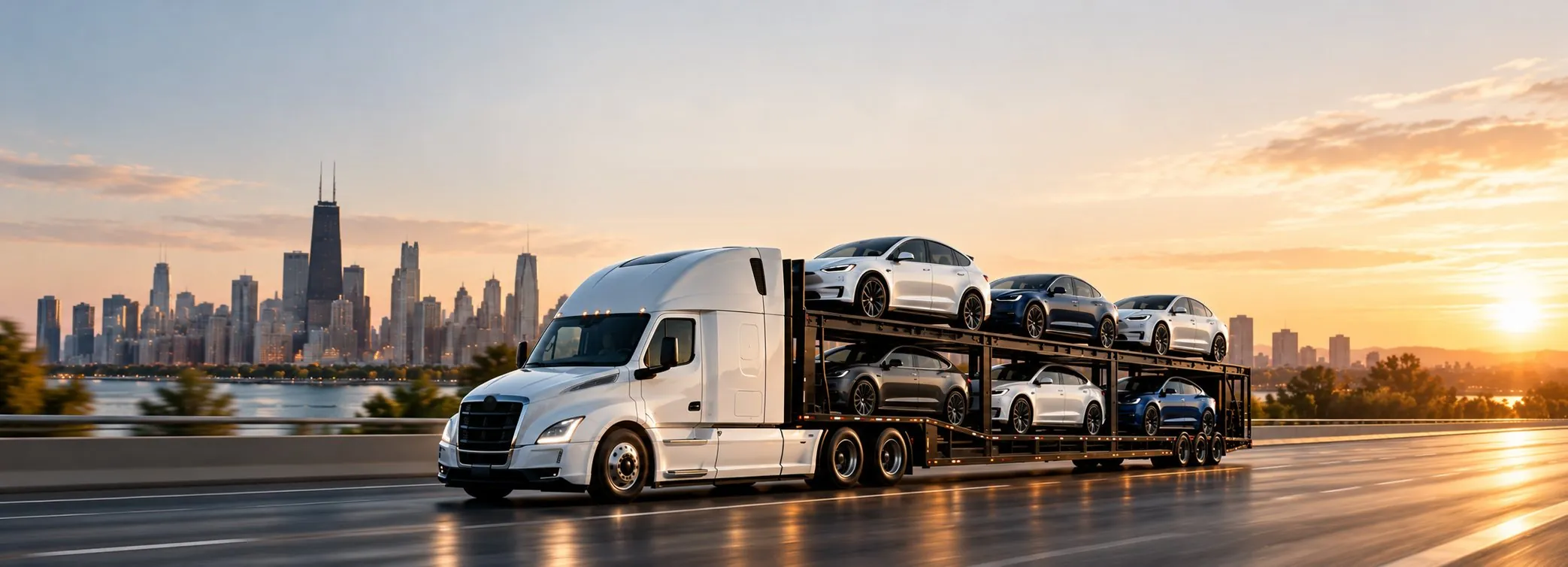
California to Texas Car Shipping
The smart choice in car shipping.
Price your own city pair
SMART PRICE PROMISE The price we quote is the price you pay, as long as the vehicle, the route, the condition and the shipping details stay the same. See the promise.
Your details stay private Your information stays private: Information you share with Smart Auto Move for the purpose of receiving a quote is used for that purpose only. We do not sell your information.
Prefer to ask AI? Get a quote from Claude, ChatGPT or another AI assistant. See how it works
Written by Richard Avery, President of Smart Auto Move · USDOT 2887232 · MC 969368
How much does it cost to ship a car from California to Texas?
The cost to ship a car from California to Texas is typically $1,000 to $1,575 on an open trailer, and takes between three to seven days in transit time. Thirteen city pairs are priced below, and the pattern in them is clear: where you start in California moves the number more than where you finish in Texas.
Smart Auto Move provides nationwide car shipping throughout the lower 48 states, backed by four strategically located staffed offices, six additional service areas, and a trusted carrier network of more than 16,000 transport professionals nationwide. Our extensive network allows us to serve customers across the continental U.S. with reliable vehicle transport from coast to coast.
Service is not currently available in Alaska, Hawaii, or Puerto Rico.
What California to Texas car shipping costs, city pair by city pair
Every row is a running mid-size car on an open trailer, taken from the figures we publish on each route’s own page, checked September 2026. California is grouped by region because that is the part that moves the price.
| City pair | Distance | Days on the road | Open transport |
|---|---|---|---|
| SOUTHERN CALIFORNIA | |||
| San Diego to San Antonio CHEAPEST | About 1,250 miles | 3 to 5 days | $1,000 to $1,150 |
| Los Angeles to San Antonio | About 1,354 miles | 3 to 4 days | $1,100 to $1,300 |
| San Diego to Dallas or Fort Worth | About 1,360 miles | 3 to 5 days | $1,150 to $1,300 |
| Los Angeles to Austin | About 1,378 miles | 4 to 5 days | $1,150 to $1,350 |
| Los Angeles to Dallas or Fort Worth | About 1,435 miles | 3 to 4 days | $1,200 to $1,350 |
| San Diego to Houston | About 1,450 miles | 3 to 5 days | $1,100 to $1,350 |
| Los Angeles to Houston | About 1,566 miles | 4 to 5 days | $1,100 to $1,400 |
| THE CENTRAL VALLEY | |||
| Bakersfield to Dallas or Fort Worth | About 1,480 miles | 4 to 5 days | $1,275 to $1,450 |
| NORTHERN CALIFORNIA | |||
| San Jose to Dallas or Fort Worth | About 1,720 miles | 4 to 6 days | $1,225 to $1,375 |
| Sacramento to Austin | About 1,750 miles | 4 to 6 days | $1,225 to $1,375 |
| San Francisco to Dallas | About 1,770 miles | 4 to 6 days | $1,375 to $1,525 |
| San Jose to Houston | About 1,900 miles | 5 to 7 days | $1,300 to $1,450 |
| San Francisco to Houston DEAREST | About 1,930 miles | 5 to 7 days | $1,425 to $1,575 |
These are estimates and not fixed prices. Fuel is the biggest line in hauling a car, and it moves, so every row is reviewed against the market. Road days are counted from the day your pickup window ends. Enclosed sits roughly 80 percent higher, and a winch truck adds $200 or more. See how our national bands work.
Your California pickup point matters more than your Texas destination
Read the table down rather than across and the pattern appears. It is the single most useful thing on this page if you have any choice about where the car starts.
Into Dallas or Fort Worth: San Diego $1,150, Los Angeles $1,200, San Jose $1,225, Bakersfield $1,275, San Francisco $1,375 at the low end. A $225 spread.
Out of San Diego: San Antonio $1,000, Houston $1,100, Dallas $1,150 at the low end. A $150 spread across the whole state.
So the California end carries about half again as much weight as the Texas end. If your car could be collected from either a Bay Area address or a Southern California one, that choice is worth more than choosing between Austin and Houston at the other end.
The reason is freight density rather than distance. Southern California is the busiest outbound market on the West Coast for car haulers, so a truck bound for Texas is already there and already filling. Northern California is quieter, and the Central Valley is off the main line altogether, which is why Bakersfield prices above Los Angeles on a trip only 45 miles longer.
California to Texas Car Shipping Questions
The questions customers ask most when planning this move.
How much does it cost to ship a car from California to Texas?
$1,000 to $1,575 for a running mid-size car on an open trailer. San Diego to San Antonio is the cheapest pair at $1,000 to $1,150 and San Francisco to Houston the dearest at $1,425 to $1,575.
Which California to Texas pair is the best value?
San Diego to San Antonio. It is the shortest of the thirteen at about 1,250 miles and the only one that starts below $1,050.
How long does the trip take?
Three to four days on the Southern California pairs, four to six from San Jose or Sacramento, and five to seven from the Bay Area into Houston. The count begins when your pickup window closes.
Why do the Northern California pairs take longer?
The car has further to go before it is even pointed at Texas. A Bay Area or Sacramento vehicle usually travels south or east within California first, which adds a day or two before the trip proper begins.
Does my California pickup city or my Texas delivery city matter more?
The California one, by about half again. Into Dallas the low end runs $1,150 from San Diego up to $1,375 from San Francisco, a $225 spread. Out of San Diego the whole state of Texas covers $1,000 to $1,150, a $150 spread.
Why does where I start in California matter so much?
Freight density rather than distance. Southern California is the busiest outbound market on the West Coast for car haulers, so a Texas-bound truck is already there and filling. Northern California is quieter and the Central Valley sits off the main line.
Why is Bakersfield dearer than Los Angeles on a similar distance?
Because it is off the corridor. Bakersfield to Dallas is only about 45 miles longer than Los Angeles to Dallas yet runs $75 higher, since the driver has to reach the car before the run east starts.
Do these prices work the same in both directions?
Out of Southern California, yes. Houston and San Diego price $1,100 to $1,350 either way, and Los Angeles and Dallas are level. Out of Northern California they do not: Dallas to San Jose runs about $150 above San Jose to Dallas, and Fort Worth to Sacramento about $200 above.
Why is the westbound leg dearer from Texas to Northern California?
A driver heading out to the Bay Area or Sacramento has fewer loads waiting there for the trip back, so the rate has to cover more of the round trip. Both ends of the Southern California lanes are busy enough that this does not happen.
I might bring the car back one day. Does that change anything?
It does if you are in Northern California. Budget for the return leg costing $150 to $200 more rather than assuming the same figure. Out of Southern California you can plan both legs on one number.
Which highways does the truck use?
I-10 for most Southern California pairs, through Phoenix, Tucson and El Paso. I-40 and US-287 by way of Flagstaff, Albuquerque and Amarillo for Dallas and Fort Worth from inland or Northern California. Inside Texas it is I-35, I-20 and I-45 depending on the delivery order.
Is there a mountain pass to worry about?
Not on I-10, which stays low the whole way and runs in any month. Flagstaff on the I-40 line sits near 7,000 feet, so a winter storm there can cost a few hours. Drivers wait it out rather than push through.
Why does the truck not take the route I would drive?
Because your car is one of eight or nine on the trailer and the driver builds a route that serves all of them. Its place in that sequence comes from geography rather than who booked first.
How soon after booking is collection?
Within six days of the earliest date you give us. Choosing expedited tightens that to three.
Is expedited worth buying on this lane?
On the Southern California pairs, often yes. Three to five days on the road means the pickup window is a large share of your total time, so halving it shortens the finish date noticeably. From the Bay Area the drive is longer and the share smaller, so buy it there for a firm start date rather than raw speed.
How much is enclosed on this route?
Add about 80 percent to the open number. Classics, collector cars, exotics and new paint are the usual reasons, and the desert stretches of I-10 and I-40 give it a second one: wind-blown grit.
What if the car no longer runs?
It travels anyway. Getting it aboard takes a winch, and that equipment adds $200 or more to the running figure. Rolling, steering and braking is all it needs. Say so when you ask for a price.
What about a truck or a big SUV?
Those go too. They occupy more trailer space, so they sit above the mid-size numbers. Describe any lift kit, larger tires or roof rack when you ask and the quote lands right.
Can an EV make this trip?
Plenty do. Bring it to around half charge before collection day and leave the charging cable inside.
Can two cars travel together?
Yes, and two vehicles from one California address to one Texas address usually cost less per car than two separate bookings.
Is it door to door at both ends?
Yes, and on this lane that works almost everywhere. Texas suburbs are wide and newer, and most of California is manageable. Downtown high-rises, gated entrances with a height bar, the hillside streets above Los Angeles and the steeper San Francisco blocks get a short meet at a wider road nearby.
Why do you want cross streets?
They let the driver settle the approach in advance instead of improvising on collection day. A ZIP on its own does not tell us which road the truck can use.
How soon do I register the car in Texas?
Within 30 days of moving, at your county tax assessor-collector office, with proof of ownership and proof of Texas insurance.
Does my car need a Texas inspection?
Texas ended the annual safety inspection for most non-commercial vehicles at the start of 2025, and a $7.50 replacement fee is collected with registration instead. Emissions testing applies in 17 counties, covering the Dallas-Fort Worth, Houston, Austin and El Paso metros.
Any California paperwork before pickup?
None. Smog testing in California attaches to registering a car there, so a vehicle on its way out of the state is not affected.
Can I pack things in the car?
Better to send it empty. The carrier’s Carrier Cargo Insurance covers the vehicle rather than its contents, and weight counts on a full trailer. Anything that must go should be small and out of sight.
Should I remove my FasTrak?
Yes. A tag left on the windshield can read as the truck passes gantries in Texas, which leaves you with charges that take time to unwind.
How much fuel should be in the tank?
About a quarter. Enough to load, unload and drive away, and light enough not to add weight across 1,500 miles.
Does someone need to be there at both ends?
Yes, though it does not have to be you. Any adult you trust can walk the car with the driver and sign the condition report at pickup and again at delivery.
How is the price protected once I book?
By the Smart Price Promise. The figure holds as long as the vehicle, the route, the condition and the shipping details match what you told us.
Will asking for a price put me on a call list?
No. We make no outbound sales calls at all. Contact concerns your own shipment, and the driver reaches out about collection and delivery.
Who insures the car in transit?
The assigned carrier, through Carrier Cargo Insurance, from pickup to delivery. We confirm the policy is active before your car goes on the load, and the certificate is yours on request.
What if the car arrives with damage?
Note it on the delivery report before the driver leaves and photograph it. That report set against the pickup one is what any claim is settled from, and we work it through with you.
How far ahead should I book?
One to two weeks suits most of the year. Summer, month ends and the weeks around the holidays run busier, and the Northern California pairs benefit from more notice because there is less traffic on them.
How do I get a figure for my own two cities?
Send the California pickup ZIP, the Texas city, the year, make and model, whether it runs, and your earliest date. Use the form on this page or call 888-709-9078, and if your pair is on the table above you already have the range.
Southern lanes cost the same both ways. Northern ones do not.
This one surprises people, and it is worth knowing before you book a round trip or bring a car back later. All of these figures are published on the routes’ own pages.
| The pair | California to Texas | Texas to California | The difference |
|---|---|---|---|
| Houston and San Diego | $1,100 to $1,350 | $1,100 to $1,350 | Level |
| Los Angeles and Dallas | $1,200 to $1,350 | $1,175 to $1,325 | Level |
| San Jose and Dallas | $1,225 to $1,375 | $1,375 to $1,525 | About $150 more westbound |
| Sacramento and Fort Worth | $1,225 to $1,375 | $1,425 to $1,575 | About $200 more westbound |
The Southern California pairs price the same in either direction because both ends are dense markets with trucks running constantly. The Northern California pairs do not, because a driver heading out to the Bay Area or Sacramento has fewer loads waiting there for the trip back.
What to do with it: if you are moving to Texas from Northern California and think you might bring the car back one day, the outbound leg is the cheaper one and the return will cost more. Budget for that rather than assuming symmetry. Out of Southern California you can plan both legs on the same figure.
The roads, and why the truck does not go your way
Carriers pick the route from the whole trailer’s worth of pickups and deliveries, not from one car. Knowing which corridor serves your pair helps the dates make sense.
I-10, the main line
Los Angeles and San Diego east through Phoenix, Tucson and El Paso to San Antonio, Austin and Houston. This is the road behind most of the Southern California rows, and it carries no mountain pass worth worrying about in any month.
I-40 and US-287
The line for Dallas and Fort Worth from inland or Northern California: over to Barstow, across to Flagstaff, Albuquerque and Amarillo, then down to the Metroplex. Flagstaff sits near 7,000 feet, so winter can cost a few hours here.
I-5 and I-80 first
A Bay Area or Sacramento car usually travels south or east within California before the trip proper starts, which is part of why those rows read four to six days rather than three to five.
Inside Texas the delivery order follows I-35 for San Antonio, Austin, Waco and the Metroplex, I-20 for West Texas and Fort Worth, and I-45 to link Houston with Dallas. If your car is one of nine on the trailer, its place in that sequence is set by geography rather than by who booked first.
All of which is why the southern pairs read three to four days while the northern ones read five to seven. It is not that one truck is faster. It is that the northern car has further to go before it is even pointed at Texas.
Open, enclosed or expedited on this lane
Almost every car on this lane rides open, and the table is priced that way throughout. Enclosed is the choice for a classic, a collector car, an exotic or new paint, with a second reason out here: the desert runs on I-10 and I-40 throw grit at windshield height. Budget about 80 percent over the open figure.
Expedited cuts the collection window from six days down to three. Out of Southern California, where the drive is three to five days, those three days are a big slice of the whole timeline and the upgrade pulls your finish date forward. Out of the Bay Area the drive is longer and the slice smaller, so there the point is a locked start date. Our standard versus expedited guide does that math in full, and the trailer decision is covered in the open and enclosed guide.
Cars that have stopped running travel this lane as well. A winch does the loading, worth $200 or more on top of the running figure, and saying so at quote time reserves the right truck.
Getting your car ready
- Send it empty. The carrier’s Carrier Cargo Insurance covers the vehicle rather than its contents, and weight counts on a full trailer.
- Leave about a quarter tank. Enough to load, unload and drive away, and light enough not to add weight across 1,500 miles.
- Take the FasTrak off the windshield. A tag left on the glass can read as the truck passes gantries in Texas, which leaves charges that take time to unwind.
- Photograph every side, the roof and the odometer before the driver arrives, and keep the pictures until the car is delivered.
- Mention a lift kit, oversized tires, a roof rack, low clearance or a starting trick when you ask for the price, so the right trailer is assigned the first time.
At pickup you or someone you trust walks the car with the driver and signs the condition report. At delivery you compare the car against that same report before the driver leaves. Those two documents are what any claim is settled from, which is why both ends are worth ten unhurried minutes.
Registering the car once it lands in Texas
- Thirty days from moving to register, at your county tax assessor-collector office, with proof of ownership and proof of Texas insurance.
- Texas ended the annual safety inspection for most non-commercial vehicles at the start of 2025. A $7.50 replacement fee is collected with registration instead.
- Emissions testing applies in 17 counties, which covers the Dallas-Fort Worth, Houston, Austin and El Paso metros. Land outside them and no test applies.
- No California step comes first. Smog testing there attaches to registering a car in the state, not to one being shipped out of it.
Every Texas rate we publish, in-state and inbound, sits on the Texas car shipping page, and the California end is covered on the California car shipping page.
Door to door, and what that means in practice
Door to door means the truck comes to your address at both ends. On this lane that works almost everywhere, because Texas suburbs are wide and newer and most of California is manageable too.
Plano, Frisco, McKinney, Round Rock, Katy, Sugar Land, The Woodlands and most of suburban Texas. In California, the valley floors, the newer Southern California tracts and the flatter Bay Area suburbs.
Downtown high-rises in Dallas, Houston and Austin, gated entrances with a height bar, the hillside streets above Los Angeles and the steeper San Francisco blocks. The driver picks a wider road or a lot nearby, about ten minutes, at no charge.
Tell us your cross streets when you book rather than just the ZIP, and the driver works the approach out before the day rather than on it.
The carrier moving your car
A single carrier from our vetted network of over 16,000 takes the car the whole way, with nothing changing trailers en route. We verify FMCSA authority is active and the insurance filing is current before anything else happens. Beyond that we weigh the trailer itself, how regularly the driver works I-10 and I-40, and how their last handful of deliveries went.
Their Carrier Cargo Insurance protects the vehicle from collection in California to handover in Texas, and we will email the certificate whenever you ask for it. Our own authority is open to anyone on the FMCSA SAFER database at USDOT 2887232, MC 969368.
What customers on this lane say
Feedback from people whose cars we have moved between California and Texas. There are more on our BBB profile, where our A+ rating and accreditation go back to 2016.




Crystal Evans was very helpful.

Every California to Texas route we price
Each of these has its own page with the full detail for that pair.