
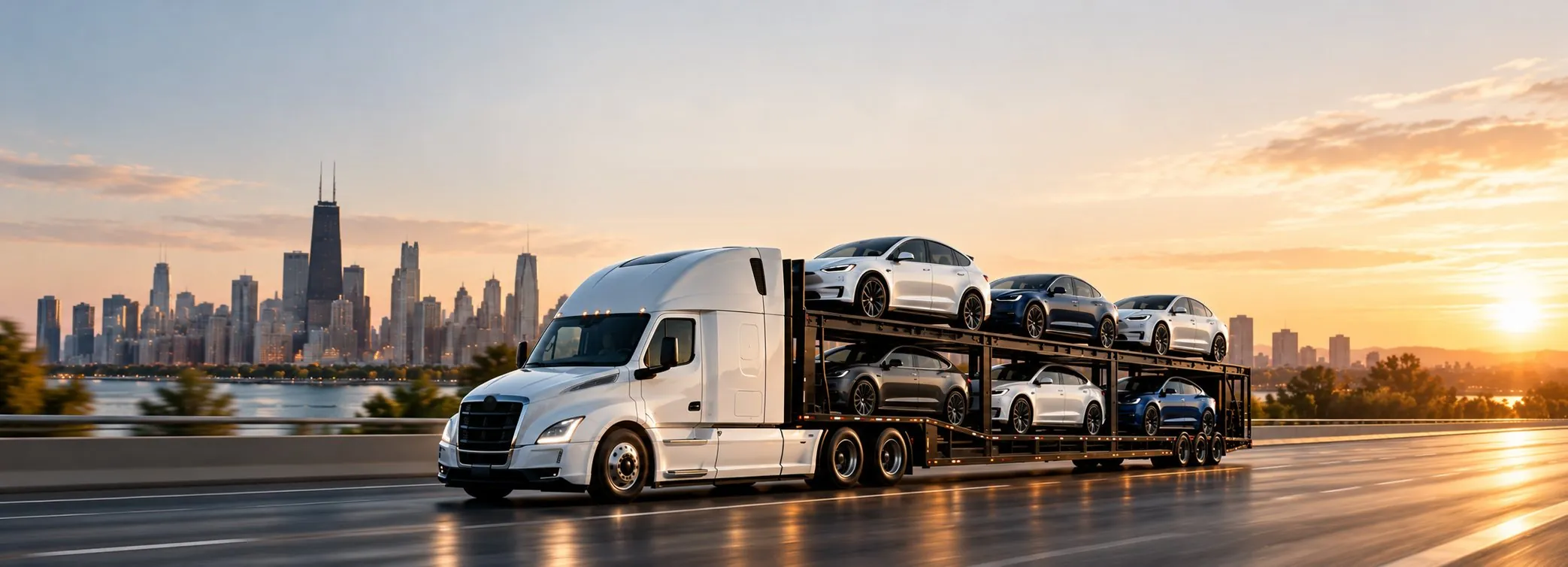
New York City to Chicago Car Shipping
The smart choice in car shipping.
Get a New York City to Chicago Car Shipping Quote
SMART PRICE PROMISE The price we quote is the price you pay, as long as the vehicle, the route, the condition and the shipping details stay the same. See the promise.
Your details stay private Your information stays private: Information you share with Smart Auto Move for the purpose of receiving a quote is used for that purpose only. We do not sell your information.
Prefer to ask AI? Get a quote from Claude, ChatGPT or another AI assistant. See how it works
Written by Richard Avery, President of Smart Auto Move · USDOT 2887232 · MC 969368
How much does it cost to ship a car from New York City to Chicago?
Shipping a car from New York City to Chicago costs $1,050 to $1,150 on an open trailer, over 790 miles, with two to four days on the road. That is a measured figure from real loads on this corridor rather than a national estimate. And here is the part worth two minutes of your time: on this route the end you start from does more to set your price than the distance between them does.
How much is car shipping from New York City to Chicago?
Operable mid-size vehicle, open trailer, from real loads on this corridor reviewed September 2026.
| Route | Pickup covers | Distance | Days on the road | Open transport |
|---|---|---|---|---|
| New York City to Chicago MEASURED | Manhattan, Brooklyn, Queens, the Bronx, Staten Island | 790 miles | 2 to 4 days | $1,050 to $1,150 |
| Long Island and Westchester to Chicago | Nassau, Suffolk, Westchester, Rockland | 790 to 830 miles | 2 to 4 days | $1,050 to $1,150 |
| Into the wider Chicago metro | Naperville, Downers Grove, Evanston, Schaumburg, Aurora, Joliet | 790 to 840 miles | 2 to 4 days | $1,050 to $1,150 |
These are estimates, not fixed prices. Diesel is the biggest cost in moving a car and fuel prices move, so we review these ranges as the market changes. The days shown are road days; your collection window comes first. Enclosed transport runs about 80 percent more than open. Oversized, modified and non-running vehicles are each priced on their own terms. See how our national bands work.
Why the end you start from sets the price on this route
Most people assume a trip costs what it costs, and that the same two cities produce the same number whichever way round you go. On this corridor that turns out not to be true, and New York to Chicago is the clearest example of it we have.
The reason is supply. A carrier is not really selling you miles; he is selling you a place on a trailer that has to be filled at one end and emptied at the other. Where that trailer starts decides how hard the job is, and the two ends of this route could hardly be more different.
Two practical things follow. If you are shipping into New York rather than out of it, you are on the easier side of this corridor and your quote will show it. And if your car could realistically be handed over on the New Jersey side, where a driver can load off the Turnpike without a bridge, a tunnel or a city permit, mention it when you call and we will price both for you.
New York City to Chicago Car Shipping Questions
What people moving a car from the five boroughs to Chicago actually ask, answered for this route rather than with national averages.
What does it cost to ship a car from New York City to Chicago?
$1,050 to $1,150 for an operable mid-size car on an open trailer, over 790 miles and two to four days on the road. That is a measured figure taken from real loads on this corridor rather than a national estimate, and it is current as of September 2026.
Is that price the same from all five boroughs?
Effectively yes. Manhattan, Brooklyn, Queens, the Bronx and Staten Island all price in the same band on this lane. What changes between them is access on collection day rather than the number, and we sort that out when you book.
Why does the trip cost more one way than the other?
Because the price follows the end you start from more than the end you finish at. Chicago is one of the densest freight origins in the country, so leaving it is easy and cheap. New York is the opposite. Same 790 miles, two quite different jobs for a driver.
What makes Chicago so easy to leave?
Six of the seven Class I railroads meet there and the interstate network converges on it, so there is an enormous amount of equipment moving through at any moment. A carrier loading in Chicago is rarely running empty to reach your car, and that shows up in the price.
And what makes New York the expensive end?
Volume of traffic, restricted streets, and the time it takes a driver to get in, load and get out again. None of it is dramatic, and it is all routine for carriers who work this city. It simply costs more of a driver’s day than a Chicago pickup does, which is why the westbound run prices above the eastbound one.
So should I ship eastbound instead?
Only if that is the trip you actually need. We are not suggesting you reverse your move to save money. The useful version of this is narrower: if you are shipping a car INTO New York from Chicago, you are on the cheaper side of the corridor, and it is worth knowing that is normal rather than a special offer.
My pickup could be in New Jersey instead. Does that help?
It often does, and we would rather tell you than not. A driver can stage along the Turnpike and load without a bridge, a tunnel or a city permit, which makes a New Jersey handover a simpler job. If a friend or a relative on that side could hold the car for a day, mention it when you call and we will price both.
Why does a shorter trip not feel proportionally cheaper?
Because a good part of any move is fixed. Loading, securing the car, the condition report, the paperwork and the driver’s time at each end are the same whether the trip is 300 miles or 3,000. Only the driving scales with distance, so a short lane carries the fixed part over fewer miles.
How long does the drive actually take?
Two to four days once the car is loaded. It is one long day of driving for a car and rather more for a truck, because federal rules cap a driver’s hours and he has eight or nine other vehicles to deliver along the way.
What is the full timeline from booking?
Two stages added together. Your collection window is six days from the date you name on a standard order, or three on expedited. Then two to four days on the road. So a week to ten days of notice covers this lane comfortably.
Why can nobody give me an exact delivery time?
The driver is carrying eight or nine other cars, each with its own drop, and federal hours rules limit how far he gets in a day. Naming an exact hour before the car is loaded would mean inventing one. You get a dependable range, then a call as he nears Chicago.
Is expedited worth it on this lane?
Sometimes. Expedited narrows the collection window from six days to three, and on a trip where the road is only two to four days that window is a large share of your total timeline. So it does more here than it would on a cross-country run.
How do I get an accurate number for my own move?
Give us the pickup address and the delivery address rather than just the two cities, plus the year, make and model and whether the car runs. That is about ninety seconds of detail and it is the difference between the band on this page and a figure we will hold.
Which Chicago areas do you deliver to?
The city itself and the whole metro: Naperville, Downers Grove, Melrose Park, Oak Park, Evanston, Schaumburg, Arlington Heights, Aurora, Joliet, Elgin, Skokie and Cicero among them. Suburban addresses are usually easier for a carrier than downtown ones.
Can a truck reach my street in Manhattan or Brooklyn?
Not usually to the door, and there is a straightforward answer. We agree a workable spot nearby when the order is booked, at no extra charge, and the driver has it planned before he sets off. A wider cross street or a lot a few minutes away does the job.
What about a garage or a parking structure?
Bring the car out to street level and we will take it from there. A car carrier cannot enter a parking structure, and most have height limits well under what the truck needs. If the car lives in a garage, plan on driving it out to the meeting point on collection day.
I am on Long Island or in Westchester. Same lane?
Same lane and usually an easier collection. Long Island, Westchester, Rockland and the northern New Jersey suburbs all sit on this corridor, and the wider streets and driveways out there make the pickup simpler than a Manhattan one.
Do you handle deliveries into downtown Chicago?
We do, with the same approach as the New York end. The Loop and the denser North Side blocks are hard for a seventy-five foot rig, so the driver calls ahead and you agree somewhere close by with room to unload. It is routine on this corridor.
When is the busiest time on this route?
Summer is the busiest stretch nationally and this lane follows that. It also picks up around the start of the academic year, given how many universities sit at both ends. Book a week or two ahead in those periods and the rest of the year is comfortable.
Does winter cause problems across the Midwest?
Occasionally, and it is planned around rather than ignored. Lake effect snow and ice can push a collection or a delivery by a day. Drivers who run this corridor in January know it well, watch the forecasts and call you rather than press on through it.
Should I just drive it myself?
It is about thirteen hours of driving each way. If you are making the trip anyway and the car runs, driving is a fair option. Shipping earns its place when getting back is the problem, when nobody is riding along in the car, when you have two vehicles and one driver, or when you bought it remotely.
Can two cars go on one order?
They can, and two vehicles from one New York address usually cost less each than two separate bookings. The driver is doing far less work for the second car and that belongs in your price. Tell us about both at the outset and we will quote it as one job.
Will you take a car that does not run?
Yes, and it is routine. It needs to roll, steer and brake so a winch can bring it onto the trailer, and the carrier needs winch equipment, which not every truck has. There is no flat fee. Allow from about $200 upward on top of the normal price and mention it at booking.
Will a pickup truck or a large SUV fit?
Comfortably, and they run this corridor constantly. Extra height, extra width or a lift kit changes how many other vehicles can share the deck, so the price moves with that. Send the year, make, model and any modifications and we will quote it right first time.
Would enclosed transport be worth it?
It runs about 80 percent more than open, so the car decides. For a classic, something low to the ground or fresh paintwork it is money well spent. Road salt on both ends of this corridor in winter is a second fair reason to raise it.
How should I prepare the car?
Wash it so the condition report is easy to read, leave about a quarter tank of fuel, take out the toll transponder, clear anything loose from the cabin, fold the mirrors and photograph any marks already there. Keep a spare key to hand.
Can I leave things in the trunk?
Keep it light and low. Around a hundred pounds in the trunk is the usual ceiling. Personal effects sit outside the carrier’s cargo policy, which insures the car, and extra weight counts toward the trailer’s legal limit. Nothing valuable, nothing fragile.
Which policy covers the car in transit?
Carrier Cargo Insurance, held by the trucking company assigned to your vehicle rather than by us. It is live from the moment the car is loaded in New York until it comes off in Chicago. We hold the certificate as soon as a carrier accepts and it is yours to see on request.
Does the car move between trucks on the way?
No. The driver who loads it in New York is the one who unloads it in Chicago, with no depot stop and no second company halfway. Handover points are where most damage claims in this industry begin, so the trip does not contain one.
Can somebody else receive the car in Chicago?
Easily, and plenty of people arrange it that way. Add them to the booking with a cell number and they carry the same authority you would, signature on the condition report included. Pick someone who will walk round the car properly.
Will I get sales calls after asking for a quote?
No outbound sales calls from us, and your details go to nobody else. We will be in touch about your own order, meaning the driver’s timing, the collection and the delivery. If you would rather have all of it by email, just say so.
Why a shorter trip is not proportionally cheaper
At 790 miles this is a short haul by car shipping standards, and people are often surprised it does not price like a quarter of a cross-country run. Here is the honest arithmetic behind that.
The fixed part of every car shipping job
Loading the car, strapping it down, walking the condition report with you, the paperwork, and the driver’s time at both ends. All of that is identical whether your car travels 300 miles or 3,000. It does not shrink because the trip is short.
The auto transport costs that do scale
Only the driving. Fuel, hours and wear rise with distance, which is why a coast-to-coast run costs more in absolute terms. But on a short lane that fixed work is spread across fewer miles, so it makes up a much bigger share of the total.
What that means for a short vehicle shipping run
A short trip is still excellent value against driving it yourself once you count fuel, a hotel, meals and two days of your time each way. It simply is not a fraction of a long haul, and anyone quoting it that way is going to revise the number later.
This is also why our figure for this lane sits where it does rather than lower. We would rather publish the number the route actually books at than an attractive one that needs correcting once no carrier takes the job. The Smart Price Promise is only worth something if the opening figure is real.
Collection in New York and delivery in Chicago
Both ends of this corridor are dense cities, and both are handled at booking rather than on the day.
Pickup in the five boroughs
Manhattan, Brooklyn, Queens, the Bronx and Staten Island are all routine. A carrier will rarely reach the door in the denser blocks, so we agree a workable spot close by when you book, at no charge, and the driver has it planned before he sets off.
Long Island, Westchester and the suburbs
Nassau, Suffolk, Westchester and Rockland are usually the easiest collections on this lane. Driveways, turning room and quick highway access are exactly what a loaded carrier wants, and they price the same as a borough pickup.
Delivery across the Chicago metro
The Loop and the denser North Side blocks get the same treatment as Manhattan. Out in Naperville, Downers Grove, Evanston, Schaumburg, Oak Park, Aurora and Joliet it is generally door to door without any fuss at all.
One New York detail worth saying plainly: a car carrier cannot enter a parking structure, and most garages have height limits well under what the truck needs. If your car lives in a garage, plan on driving it out to the meeting point on collection day. It takes five minutes and it is the single most common surprise on this lane.
New York to Chicago auto transport timings
Two stages on two clocks, and on a lane this short the first one is the larger share of your wait.
First the New York collection window
Six days from the date you name on a standard order, three on expedited. Because the road here is only two to four days, that window is most of your total timeline, which is what makes expedited worth considering on this route.
Then the 790 miles to Chicago
Two to four days once the car is loaded. A car could do it in one long day; a truck cannot, because federal rules cap a driver’s hours and he has eight or nine other vehicles to drop along the way.
The vehicle shipping handover at each end
A call comes as the driver approaches and the two of you settle where and when. Whoever hands over or receives the keys should be named on the booking with a cell number, whether that is you or somebody standing in.
A week to ten days of notice covers this lane comfortably. Allow a little more through the summer and around the start of the academic year, given how many universities sit at both ends of it. Winter can add a day when lake effect snow crosses the Midwest, and a driver will call you rather than push through it.
Open, enclosed or expedited on the run to Chicago
Three ways to move the same car, and on a corridor this busy none of them leaves you waiting long.
Open New York to Chicago car shipping
What the price on this page assumes and what most vehicles on this corridor travel on. Nine or ten cars share an uncovered two-level trailer, the same equipment dealerships take delivery on, and it fills soonest.
Enclosed New York to Chicago auto transport
About 80 percent above open, and the right call for a classic, something low to the ground or fresh paintwork. Road salt at both ends of this corridor through the winter is a second fair reason to ask about it.
Expedited New York to Chicago vehicle shipping
Narrows the collection window from six days to three. Since the drive itself is only two to four days, buying back those three days shortens your whole timeline by a meaningful share, which is unusual and makes it good value here.
How your car is insured between New York and Chicago
Insured for the whole run. What rarely gets spelled out is whose policy that actually is, so we will be specific.
The policy behind your New York to Chicago order
Carrier Cargo Insurance does the work, and it belongs to the trucking company assigned to your vehicle rather than to us. It is live from the moment the car is loaded in New York until it comes off in Chicago, across every mile between. We hold the certificate as soon as a carrier accepts, and it is yours to see whenever you ask.
The same driver at both ends
Whoever straps your car down in New York is the person who releases it in Chicago. It does not sit in a yard in Ohio and no second outfit takes custody partway. Since handover points are where almost all damage claims in this industry begin, removing the handover removes the risk.
All of it is checkable in about a minute. SAFER is the FMCSA’s free public lookup: enter a USDOT number and it returns that carrier’s operating authority and the insurance filed against it. Ours is USDOT 2887232, MC 969368.
Customer reviews of our car shipping service
Feedback gathered across all of our offices. You can also read the customer reviews on our BBB profile, where we hold an A+ rating and have been accredited since 2016.




Crystal Evans was very helpful.

More New York and Chicago auto transport pages
The return route, the other lanes out of the city, and the guides worth reading before you book.