
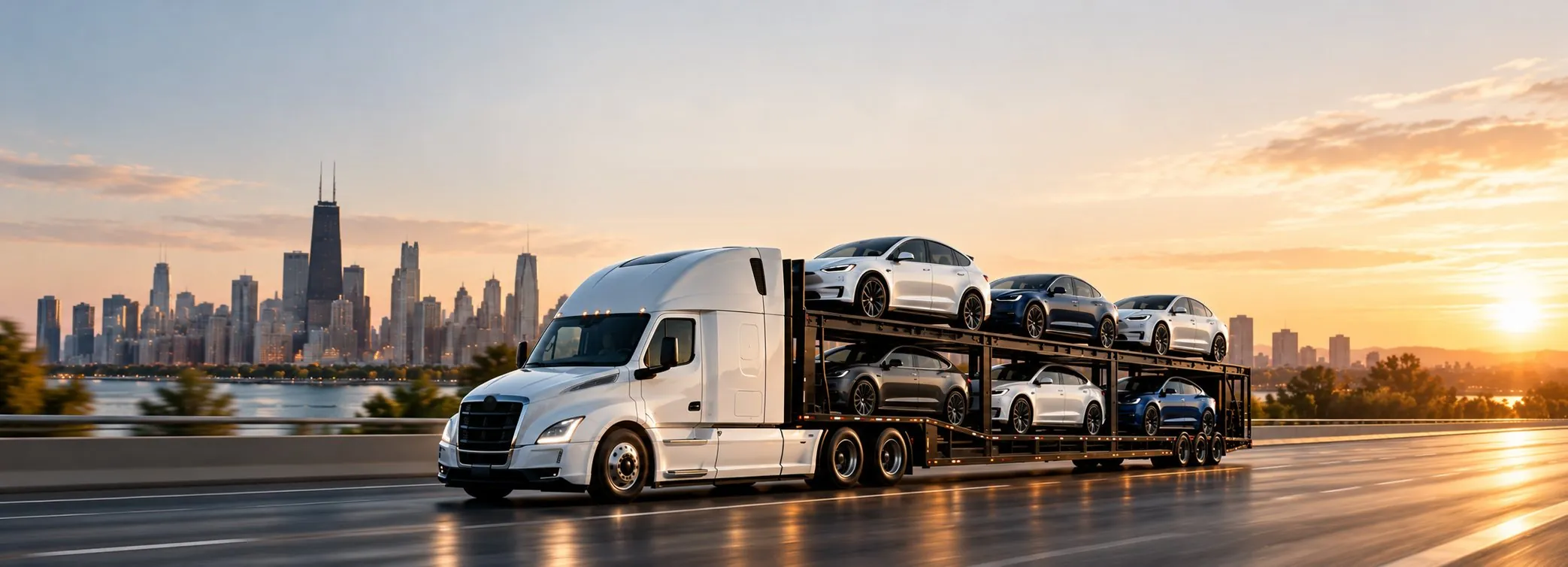
New York City to Seattle Car Shipping
The smart choice in car shipping.
Get a New York City to Seattle Car Shipping Quote
SMART PRICE PROMISE The price we quote is the price you pay, as long as the vehicle, the route, the condition and the shipping details stay the same. See the promise.
Your details stay private Your information stays private: Information you share with Smart Auto Move for the purpose of receiving a quote is used for that purpose only. We do not sell your information.
Prefer to ask AI? Get a quote from Claude, ChatGPT or another AI assistant. See how it works
Written by Richard Avery, President of Smart Auto Move · USDOT 2887232 · MC 969368
How much does it cost to ship a car from New York City to Seattle?
Shipping a car from New York City to Seattle costs $1,800 to $2,000 on an open trailer, over 2,850 miles, with seven to ten days on the road. Those figures come from loads that actually moved along this route. It is also one of the longest domestic runs there is, and there is one thing about it worth knowing: of those 2,850 miles, the ones that decide your delivery day are usually the last sixty.
What New York City to Seattle car shipping costs
Operable mid-size vehicle, open trailer, from real loads on this corridor reviewed September 2026.
| Route | Cities covered | Distance | Days on the road | Open transport |
|---|---|---|---|---|
| New York City to Seattle MEASURED | Manhattan, Brooklyn, Queens, the Bronx, Staten Island | 2,850 miles | 7 to 10 days | $1,800 to $2,000 |
| Into the wider Puget Sound | Bellevue, Redmond, Kirkland, Everett, Renton, Kent, Tacoma | 2,850 to 2,900 miles | 7 to 10 days | $1,800 to $2,000 |
| Seattle area back to New York THE RETURN LEG | The same corridor in reverse | 2,845 miles | 7 to 10 days | $1,850 to $2,000 |
Notice how close the two directions are. On plenty of corridors one direction costs hundreds less than the other, and we say so on those pages. This is not one of them: New York to Seattle and Seattle back to New York sit almost on top of each other. If you are weighing a move in either direction, the price will not be the thing that decides it.
These are estimates, not fixed prices. Diesel is the biggest cost in moving a car and fuel prices move, so we review these ranges as the market changes. The days shown are road days; your collection window comes first. Enclosed transport runs about 80 percent more than open. Oversized, modified and non-running vehicles are each priced on their own terms. See how our national bands work.
The last sixty miles are the ones that matter
Your car will cross ten states to reach Seattle. Almost all of it is ordinary interstate work that a driver handles without a second thought. Then, about sixty miles short of the city, it meets the one piece of road on this entire route that can actually change your delivery day.
Interstate 90 crosses the Cascades at Snoqualmie Pass, just over 3,000 feet up. It is the lowest of Washington’s year-round east to west crossings and the primary commercial artery into Seattle from the east, which means essentially every loaded carrier coming your way goes over it. The area around it averages more than 400 inches of snow a year.
So the advice for a winter shipment is not to change your plans, it is to carry a day of slack in them. Tell us when you book if your delivery date is fixed, and we will build the schedule with that margin already in it rather than cutting it fine and hoping. From April to October the pass barely enters the conversation.
New York City to Seattle Car Shipping Questions
What people moving a car from the five boroughs to the Pacific Northwest actually ask, answered for this route rather than with national averages.
What does it cost to ship a car from New York City to Seattle?
$1,800 to $2,000 for an operable mid-size car on an open trailer, over 2,850 miles and seven to ten days on the road. That is a measured figure from real loads on this corridor rather than a national estimate, and it is current as of September 2026.
Is the trip back priced the same?
Close to it. The Seattle area up to New York runs $1,850 to $2,000, so the two directions sit almost on top of each other. On some corridors one direction is far cheaper than the other; this is not one of them, and that is worth knowing if you are planning a move in either direction.
You mention a mountain pass. Which one and why does it matter?
Snoqualmie Pass, where Interstate 90 crosses the Cascades about sixty miles east of Seattle at just over 3,000 feet. It is the main commercial road into the city from the east, and in winter it can call for chains on large trucks and occasionally closes outright when conditions turn extreme.
Out of 2,850 miles, that one stretch decides my delivery?
In winter it often does. The rest of the route across the northern states is ordinary interstate driving that a driver handles without drama. The pass is the single point where weather can hold a truck for a few hours or, rarely, a day. It is the last thing between your car and Seattle.
How much snow does it actually get?
The area around the pass averages over 400 inches a year, which is why it has chain rules and avalanche control built into how it operates. None of that is unusual for the people who run this route. It is simply part of the job between November and March.
So should I avoid shipping to Seattle in winter?
Not at all, and we do it every winter. What it asks for is a day of slack in your plans rather than a change of season. Tell us if your delivery date is fixed and we will build the schedule with that margin in it rather than cutting it fine.
What do drivers actually do when the pass is bad?
They wait it out, usually for hours rather than days, and they call you. Carriers who work this corridor watch the pass reports the way everyone else watches the weather, and they will sit east of it rather than push into a closure. That is the right call every time.
Is there another way into Seattle?
There are other Cascade crossings but I-90 is the lowest of the year-round routes and the one built for commercial traffic. A carrier is not going to take a loaded seventy-five foot rig over a smaller mountain highway to save an afternoon, and you would not want him to.
How long does the whole thing take?
Seven to ten days on the road once the car is loaded, plus your collection window before it. Two to three weeks from booking to delivery is the realistic planning figure on a standard order, and a little more if you are moving in deep winter.
Why can nobody give me an exact delivery day?
Federal rules cap how many hours a driver can be at the wheel and he has other cars to drop across the northern states on the way. A day named before the car is loaded would be invented. You get a dependable range, then a call as he approaches Washington.
Does paying extra for expedited help here?
Honestly, not as much as it would elsewhere. What you buy is a shorter wait for collection, three days instead of six. The crossing stays at seven to ten regardless, and since the crossing dominates the timeline on this route, most of your wait is untouched.
What sort of lead time should I allow?
Aim for two to three weeks, stretching that through summer when demand peaks across the country. Where you have an immovable date at the far end, booking sooner simply makes everything else easier on a journey this long.
Which Seattle areas do you deliver to?
The city and the whole Puget Sound region: Bellevue, Redmond, Kirkland, Everett, Renton, Kent, Federal Way, Auburn, Tacoma and down to Olympia. The suburbs are generally easier for a carrier than the city itself.
Seattle has some steep, narrow streets. Is that a problem?
It is the one local wrinkle at the delivery end. Queen Anne, Capitol Hill, Fremont and parts of Ballard combine hills with narrow streets and parked cars, which is hard work for a long trailer. We agree a flatter, wider spot nearby when you book, at no charge.
Can a carrier reach my address in Manhattan or Brooklyn?
In the denser blocks, usually not to the door, and that is routine. At booking we pick a workable spot close by, a broader cross street or an open lot within a few minutes, and it costs you nothing. The driver has that location before he sets off.
My car is parked in a garage. What do I do?
Bring it up to street level on the day. Parking structures are off limits to a car carrier and the clearance in nearly all of them is far below what the truck needs. A couple of minutes’ work, and it is the detail New York customers most often overlook.
Why is there a collection window rather than a date?
A trailer leaves full, and filling one bound for the Pacific Northwest takes longer to arrange than filling one going two states over. Standard orders work to a six day spread around your chosen date and expedited tightens it to three.
Am I better off driving it across?
Only if you want the journey for its own sake. The realistic arithmetic is four or five demanding days at the wheel, fuel and food across ten states, three or four nights paid for, and then the identical trip in reverse to get yourself home. Shipping generally undercuts that on money and hands you back the better part of two weeks.
I am flying out and want the car waiting. How do I time that?
Work backward from your arrival date rather than forward from today. The road alone is seven to ten days and the collection window sits in front of it, so the booking wants to go in two to three weeks ahead rather than the same week as your flight.
We are sending two vehicles. Better together?
Considerably. Booked as one job, each car comes in under what it would cost alone, and across 2,850 miles that gap is wider than it would be on a regional move. The driver does barely any additional work for the second vehicle and the price reflects that.
Will you take a car that will not start?
Yes, and it is routine. The wheels have to turn, the steering has to work and the brakes have to hold so a winch can draw it up the ramp, and the assigned truck has to carry winch gear, which not all do. No flat fee applies. Allow from about $200 upward and say so at booking.
Is my truck too big for this?
Almost certainly not. Full-size pickups and large SUVs make this crossing constantly. Pricing tracks the space taken on the deck, so raised suspension, wider tires or a long bed each shift it. Pass on the year, make, model and any alterations and we will be accurate first time.
Is enclosed transport worth it across the northern route?
It runs about 80 percent above open, and the length of this trip is a genuine argument for it. Your car is outdoors for seven to ten days, some of it through winter weather across the mountain states. For a classic or fresh paintwork that is worth weighing carefully.
Does road salt come into it?
Only if the car is on an open trailer through a winter crossing, and even then it is the same exposure the car would get sitting outside at either end. If that bothers you for a particular vehicle, enclosed transport is the answer rather than a different season.
What should I do the night before pickup?
A wash, so the condition report is unambiguous. Fuel down near a quarter tank, toll transponder out, cabin cleared of loose items, mirrors folded in, and a photograph of every panel that already carries a mark. Set a spare key aside.
Any room for luggage in the back?
Keep it to roughly a hundred pounds, stowed low. Bear in mind the cargo policy protects the car and not what is inside it, and that whatever you add counts against the rig’s permitted weight. Over 2,850 miles, send nothing you could not stand to lose.
Who is actually insuring my car out there?
The trucking company we assign it to, under Carrier Cargo Insurance. The policy is theirs rather than ours. It takes effect as the car goes up the ramp in New York and stays in force until it comes down again in Seattle. We receive the certificate on acceptance and will send it over if you want to see it.
Does the car change trucks partway?
No, and on a crossing this long that matters. One truck and one driver carry it from New York to Seattle, with no yard stop in the middle and no second company involved. Handover points are where most damage claims in this industry begin.
Someone else will be in Seattle to receive it. Fine?
Perfectly fine, and common here since people often fly out on different days. Put their name and a cell number on the booking and they can accept the vehicle and sign the condition report exactly as you could.
Will asking for a price lead to chasing calls?
It will not. We do not run outbound sales calls, and your details are never passed along. Everything we send you relates to the shipment itself and nothing besides. Tell us you prefer writing and the whole thing happens over email.
Shipping the car or driving it across the northern states
At 2,850 miles this is among the longest moves anyone makes inside the country, so the comparison deserves doing honestly.
What driving it yourself really involves
Four to five days of hard driving each way, three or four nights in motels, fuel across ten states and meals on top. Then 2,850 miles of wear and depreciation on the car you are moving, and every mile of it again if anyone has to come back.
The winter auto transport route is harder still
The same mountain pass that can hold a professional driver for a few hours is a genuinely demanding drive for someone doing it once. Chains, closures and long empty stretches across Montana and Idaho are routine for a carrier and a serious undertaking for the rest of us.
When the drive genuinely wins
If the trip is something you want rather than something you have to solve, take it. The northern route in summer is one of the great American drives. Ask us for the comparison and you will get a straight one rather than a sales answer.
The common pattern here is a flight out with the car following, often for a job starting at a fixed date. If that is you, work backward from the arrival rather than forward from today. The road alone is seven to ten days and the collection window sits in front of it, so two to three weeks of lead time is the realistic habit.
Collection in New York and delivery around Puget Sound
Two dense cities at either end, each with its own wrinkle, and both settled at booking rather than on the day.
Getting the car out of the city for auto transport
Every borough is familiar ground: Manhattan, Brooklyn, Queens, the Bronx, Staten Island. On the narrower blocks the handover happens at a practical point a short distance away rather than outside your building, fixed at the time of booking and carrying no surcharge.
If the car is kept in a garage
Parking structures are off limits to a car carrier and the clearance in almost all of them falls well short of what the truck needs. Bring the vehicle up to the street yourself on the day. It is the detail New York customers most often have not thought about.
Seattle’s hills and narrow streets
The wrinkle at the far end. Queen Anne, Capitol Hill, Fremont and parts of Ballard combine steep gradients with narrow streets and cars parked both sides, which is hard work for a long trailer. A flatter, wider spot nearby solves it.
Out in Bellevue, Redmond, Kirkland, Renton, Kent, Everett and down toward Tacoma, deliveries are generally straightforward and door to door is the normal outcome. If your Seattle address is on one of the steeper streets, say so when you book and the driver will have a plan for it long before he reaches Washington.
New York to Seattle auto transport timings
Two stages on two clocks, and on a crossing this long the road is much the larger share of the wait.
Stage one, waiting for the vehicle shipping trailer
You will have a six day spread around your chosen date, or three if you pay for expedited. Trailers depart loaded, and assembling one headed for the Pacific Northwest is slower work than assembling one bound for the next state but one.
Stage two, the 2,850 miles west
Seven to ten days once the car is loaded. Federal rules cap a driver’s hours behind the wheel and he has other vehicles to drop across the northern states on the way, and between them those set the pace.
The Seattle handover
You get a call once the driver is closing on Washington, and the two of you settle the spot and the hour between you. Add whoever will actually be there to the order along with a cell number; on this route that is frequently someone who flew out days earlier.
Two to three weeks of notice is the comfortable habit on this route, and a little more through the summer, which is the busiest stretch nationally. Between November and March, add the day of slack described above and the whole thing stays relaxed. April through October the route behaves like any other long haul.
Open, enclosed or expedited on the run to Seattle
Three ways to move the same car, and on a crossing this long the choice earns a moment’s thought.
Open New York to Seattle car shipping
The basis for every price quoted here, and the choice for the great majority of cars crossing this way. Your vehicle rides alongside eight or nine others on a two-level uncovered rig, identical to how showrooms receive new stock, and these fill fastest of all.
Enclosed New York to Seattle auto transport
Around 80 percent above open, and the length of this trip makes it a fairer question than usual. The car is outdoors for seven to ten days, some of that through mountain weather in winter. For a classic or fresh paintwork it is worth weighing properly.
Expedited New York to Seattle vehicle shipping
Cuts the wait for collection from six days down to three. Because the hours a driver may work are capped regardless of what you paid, the crossing itself does not shorten, and across 2,850 miles that makes this a thinner benefit than on a short lane. Worth knowing before you spend on it.
How your car is insured between New York and Seattle
Your vehicle is insured across all ten states. The question nobody answers clearly is whose policy is actually behind that, so we will answer it here.
The policy behind your New York to Seattle order
Carrier Cargo Insurance does the work, and it belongs to the trucking company assigned to your vehicle rather than to us. It is live from the moment the car is loaded in New York until it comes off in Seattle, across every mile between. We hold the certificate as soon as a carrier accepts, and it is yours to see whenever you ask.
One driver, New York to Puget Sound
The person who secures your car at the start is the person who releases it at the end. No stopover in a Chicago yard, no transfer to another operator in the middle of the country. That single detail removes the step where the bulk of this industry’s damage claims originate, and on a run of this length it is worth more than on any short hop.
All of it is checkable in about a minute. SAFER is the FMCSA’s free public lookup: enter a USDOT number and it returns that carrier’s operating authority and the insurance filed against it. Ours is USDOT 2887232, MC 969368.
Customer reviews of our long distance service
Feedback gathered across all of our offices. You can also read the customer reviews on our BBB profile, where we hold an A+ rating and have been accredited since 2016.




Crystal Evans was very helpful.

More New York and Pacific Northwest car shipping pages
The return route, the other coast to coast lanes, and the guides worth reading before you book.