
Open Auto Transport
The smart choice in car shipping.
Get an Open Auto Transport Quote
SMART PRICE PROMISE The price we quote is the price you pay, as long as the vehicle, the route, the condition and the shipping details stay the same. See the promise.
Your details stay private Your information stays private: Information you share with Smart Auto Move for the purpose of receiving a quote is used for that purpose only. We do not sell your information.
Prefer to ask AI? Get a quote from Claude, ChatGPT or another AI assistant. See how it works
Written by Richard Avery, President of Smart Auto Move · USDOT 2887232 · MC 969368
How much does open car shipping cost?
Open auto transport moves your car on a trailer with no roof and no sides, and it costs $450 to $900 under 500 miles, rising to $1,600 to $2,500 coast to coast. It is how the large majority of cars in this country are shipped, including almost every new one delivered to a dealership. Below you will find those price bands with a real measured load published inside each one, so you can see where the numbers come from.
What open auto transport costs, and the loads behind each figure
Operable mid-size vehicle on an open trailer. The left column is our national band for that distance. The right is a route where we have gone through the loads one at a time and published what we found.
| Distance | National band | A route we measured | What it came in at |
|---|---|---|---|
| Under 500 miles | $450 to $900 | Atlanta to Orlando, 439 miles | $600 to $725 |
| 500 to 1,500 miles | $900 to $1,600 | New York City to Chicago, 790 miles | $1,050 to $1,150 |
| 500 to 1,500 miles | $900 to $1,600 | Chicago to Tampa, 1,180 miles | $825 to $975 |
| 1,500 to 2,500 miles | $1,250 to $2,100 | New York City to Dallas, 1,549 miles | $1,350 to $1,600 |
| Over 2,500 miles | $1,600 to $2,500 | New York City to Seattle, 2,850 miles | $1,800 to $2,000 |
Look at the Chicago to Tampa row, because it is the honest one. That route starts at $825 over 1,180 miles, which is below the $900 floor of the band it sits in. We could have left it out and the table would look tidier. It is there because it tells you something true: the bands are national averages, and a busy corridor with freight moving both ways beats the average. Chicago is one of the densest freight origins in the country and Florida is a dense inbound market, so a car there fills a space on a trip that was already happening. On a quiet corridor the same distance runs above the band instead. That is why we measure routes one at a time and publish what we find, rather than asking you to take a band on trust.
These are estimates, not fixed prices. Diesel is the biggest cost in moving a car and fuel prices move, so we review these ranges as the market changes. The days shown are road days; your collection window comes first. Enclosed transport runs about 80 percent more than open. Oversized, modified and non-running vehicles are each priced on their own terms. See how our national bands work.
What an open trailer actually is
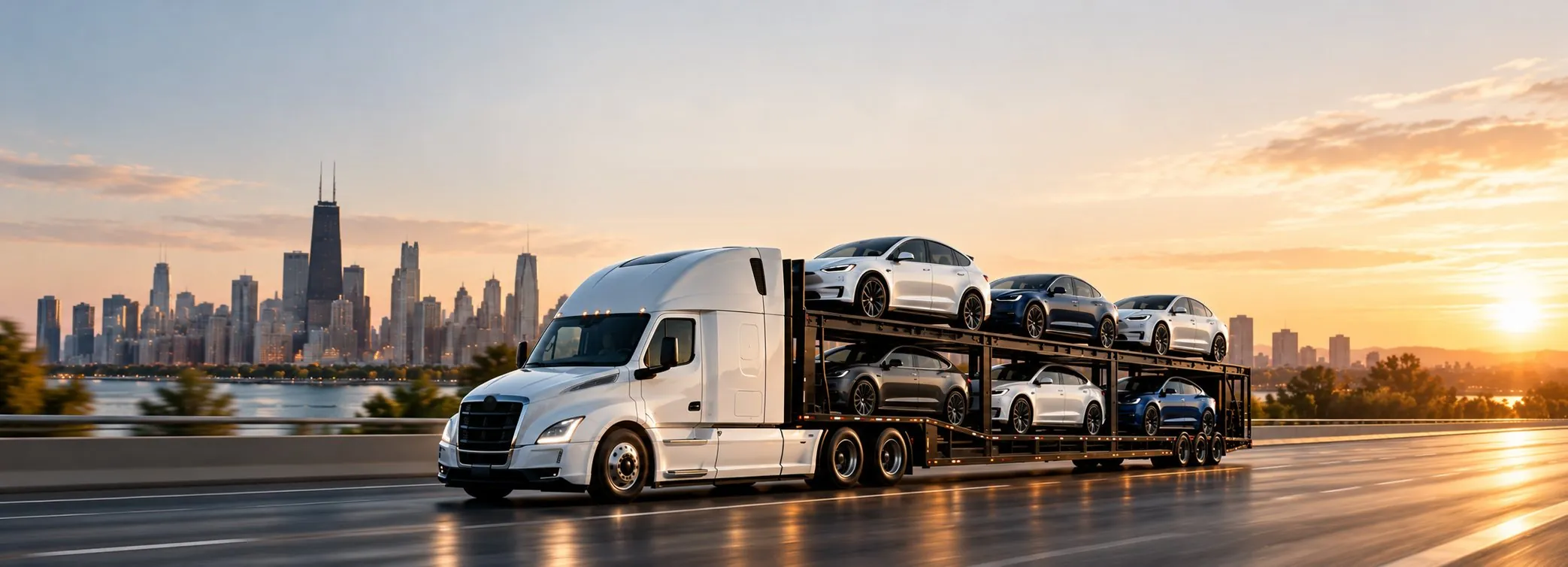
People picture something improvised. It is not. An open car carrier is a purpose-built two-deck trailer, roughly 75 feet long once it is coupled to the tractor, with hydraulic ramps and individual tie-down points for each vehicle. Nine or ten cars travel on it at once.
The thing worth knowing is who else uses them. Manufacturers move millions of brand new vehicles this way every year, from the factory to the showroom floor, and they have every commercial reason to choose something more protective if it were needed. The trailer that brought the cars to your local dealer is the same kind of trailer we would put yours on.
One more practical point about the deck. Whether your car rides upstairs or down is the driver’s call on the day, decided by weight, height and the order of his drops. Both positions are equally secure. If your vehicle sits unusually low or stands unusually tall, tell us at the quote stage rather than at the curb, because that genuinely affects which position and occasionally which trailer suits it.
Open Auto Transport Questions
What people actually ask before choosing an open trailer, answered without the sales gloss.
What is open auto transport?
It is a vehicle moved on a trailer with no roof and no sides. Nine or ten cars travel together on two decks, strapped down at the wheels. It is the same equipment every franchise dealer in the country receives new inventory on, and it carries the large majority of cars shipped in the United States.
What does open auto transport cost?
By distance. Under 500 miles, $450 to $900 for an operable mid-size vehicle. From 500 to 1,500 miles, $900 to $1,600. From 1,500 to 2,500 miles, $1,250 to $2,100. Beyond 2,500 miles, $1,600 to $2,500. The table on this page puts a real measured load inside each of those bands.
Why show measured loads next to the bands?
Because a band on its own is just a claim. We work through corridors load by load and publish what we find on the route pages, so it costs us nothing to show you the evidence here. It also lets you see the honest part: two of those measured lanes come in below their band.
How can a real lane cost less than the band says?
Because the bands are national and some corridors are much busier than average. Chicago to Tampa starts at $825 over 1,180 miles, under the $900 floor for that distance. Both ends are dense freight markets with traffic running two ways, so a car fills a space on a trip already happening.
Does that mean the bands are too high?
No, it means they are averages. On a quiet corridor the same distance costs more than the band, and on a busy one it costs less. That is why we publish measured figures per route wherever we have done the work, and quote live where we have not.
Is open transport safe for my car?
Yes, and the volume is the reassurance. Manufacturers move millions of brand new cars this way every year rather than choosing something more protective. Your vehicle is secured at the wheels rather than the body, and it is exposed to the same weather it would meet being driven.
What is the difference between open and enclosed?
A roof and walls, and about 80 percent on the price. Enclosed trailers carry fewer vehicles, so each one costs more. Open is the right answer for a daily driver. Enclosed earns its money on a collector car, fresh paintwork, low bodywork or anything where a stone chip is a real expense.
When should I pay for enclosed instead?
When the car is worth protecting rather than simply worth moving. Classics, exotics, show cars, restorations and anything freshly painted are the clear cases. A long winter route across salted highway is a reasonable second reason. Ask us to price both and decide with the two figures in front of you.
How many cars are on an open trailer?
Usually nine or ten, on two levels. That shared capacity is the whole reason open transport is the cheaper option: the cost of the truck, the fuel and the driver’s day is divided across everything on the deck rather than carried by your car alone.
Does my car ride on the top or bottom deck?
The driver decides on the day, based on weight, height and the order of his drops. Both are equally secure. If your car is particularly low or particularly tall, say so at the quote stage, because that genuinely affects which position and sometimes which trailer suits it.
What actually moves the price?
Distance first. Then vehicle size and weight, because a trailer is limited by both. Then how busy your corridor is, whether the car runs, and how much flexibility you can give on the collection date. Season matters too, since summer and the snowbird months are the busiest.
How do I get the price down?
Widen the collection window and book a week or two ahead. A driver with one space left takes whichever car is convenient rather than driving further for a better-paid one. Every extra day you can offer is another chance to be that convenient car.
What is a collection window?
The spread of days we work within to get a trailer to you, six days as standard or three with expedited. It sits before the road days rather than inside them. Adding the two together wrong is the most common reason a shipment seems late when it is running to plan.
How long does the road part take?
One to three days under 500 miles. Two to five days out to 1,500. Four to eight days to 2,500. Seven to ten days coast to coast. Federal rules cap the hours a driver may spend at the wheel, and there are other cars coming off along the way. Those two things set the pace.
Is expedited worth paying for?
It depends on the distance, and we will tell you which side you are on. It tightens the collection window from six days to three and does nothing to the drive. On a short run that window is most of your timeline and the money buys you dates. Coast to coast it is a much thinner benefit.
Does door to door cost extra on an open trailer?
No. Door to door is how we run every open shipment and it is already inside the prices above. Where a street cannot take a 75-foot rig safely, the driver arranges a spot a short walk away, and that is included rather than charged for.
Why can the truck not always reach my door?
Length, mostly. A loaded open trailer is around 75 feet and needs somewhere to stop, load and pull away without blocking a road or scraping a tree. Narrow streets, low branches, tight corners and heavy parked cars are the usual reasons we agree a nearby spot instead.
Who insures my car on an open trailer?
Carrier Cargo Insurance, and the policy belongs to the trucking company assigned to your vehicle rather than to us. It is live from loading to unloading with nothing uncovered between. We hold the certificate as soon as a carrier accepts the job and will send it whenever you ask.
Can I verify the carrier before it arrives?
Yes, on a government database, in about a minute. SAFER is the FMCSA’s free public lookup. Enter a USDOT number and it returns whether that company holds authority to operate and what insurance sits on file for it. Ours is USDOT 2887232, MC 969368.
Does my car get moved between trailers?
Not with us. Whoever loads it is whoever unloads it, with no second company partway and no night in a storage yard. Damage in this business clusters at exactly that transfer, so a route without one removes the opportunity rather than insuring against it.
Can I leave belongings in the car?
Usually yes, within reason. Keep it to around a hundred pounds, in the trunk and below the window line so the driver can see out. Carrier Cargo Insurance covers the vehicle rather than its contents, so anything valuable or hard to replace is better carried with you.
How should I prepare the car?
Wash it, because dirt hides the marks the condition report should record. Take your things out. Leave about a quarter tank of fuel. Turn the alarm off. Then photograph all four corners in daylight. Five minutes of that makes the handover at the far end simple.
Why only a quarter tank of fuel?
Weight. A full tank adds real pounds to a trailer that is already loaded to a legal limit, and a quarter is plenty to drive on and off. It is a small thing, but multiply it across ten cars and it matters to the driver.
What happens at pickup?
The driver walks the car with you and writes a condition report, noting any existing marks. You both sign it. Then he loads and secures the vehicle. Keep a copy, because that document is what any conversation at the far end refers back to.
What happens at delivery?
The driver calls ahead and you agree a spot and a time. Then you compare the car against the pickup condition report before signing it off. Do that in daylight if you can, and take your own photographs again while you are there.
Can you ship a car that does not run?
Yes, on a trailer fitted with a winch and a driver equipped to use it. Budget $200 upward on top of the prices above. Three answers decide which rig we send, so have them ready: does it roll, does it steer, does it brake.
What about a pickup truck, a large SUV or a van?
All standard on open trailers. Bigger means more deck and more weight, so it prices above a mid-size sedan. Send the year, make and model plus any lift kit or oversized tires, and we will price the vehicle you actually own rather than a size bracket.
Can I ship two cars on the same trailer?
Yes, and it is worth asking about. Two vehicles to the same address save the driver a stop, and that efficiency shows up on the second car. Quote them together rather than as two separate orders.
Can an electric vehicle go on an open trailer?
Yes, and plenty do. Bring it to about half charge, give us the exact model so the weight is right, and switch off anything that wakes the car while it sits. The heavier EVs price a little above a comparable gas car, because weight is what a trailer is limited by.
Is there a busy season for open transport?
Two. Summer is the heaviest, with family and college moves in the same months. Then October through April the snowbird corridors fill southbound and reverse in spring. Booking two to three weeks out matters most in those stretches.
Do I have to be there in person?
Someone does, to release or receive the car and sign the condition report, but it need not be you. Any responsible adult will do: a partner, a relative, a neighbor, a building superintendent, a coworker. Give us their name and a cell number at booking.
Will the final bill match the quote?
Yes. The price we quote is the price you pay, as long as the vehicle, the route, the condition and the shipping details stay the same. That is the Smart Price Promise, and it is why this page shows you the loads behind the bands rather than asking you to take the bands on trust.
Open or enclosed, decided properly
Enclosed transport costs about 80 percent more than open. That is the whole decision, so here is how to make it in about a minute.
Open is right for most cars
A daily driver, a family SUV, a work pickup, a car being sold or bought normally. If the vehicle already lives outdoors and gets driven in the rain, a trailer with no roof changes nothing about its life. This covers the large majority of what we move.
Enclosed earns its money here
Classics, exotics, show cars, restorations and anything freshly painted. Very low bodywork, where ramp clearance matters as much as the roof. And any car where a single stone chip is a genuine expense rather than an annoyance.
The honest middle ground
A long winter route across salted highway is a fair reason to consider enclosed even for an ordinary car, and so is a vehicle you are about to sell. Ask us to quote both. Two numbers side by side settle this faster than any amount of description.
What moves an open transport price
Five things, in roughly the order they matter.
Distance, then the corridor
Distance sets the band. How busy your particular corridor is decides where inside it you land, or whether you fall outside it altogether. Two routes of identical length can differ by hundreds of dollars for no reason other than how many trucks run them.
Size and weight
A trailer is limited by both, so a large SUV or a dually takes space and capacity that a sedan does not. A lift kit or oversized tires can change which deck position works. Tell us the exact vehicle and any modifications and the quote reflects reality.
Whether it runs
A car that rolls, steers and brakes can be winched. One that does none of those needs different equipment again. Budget $200 upward on top of the bands for a non-running vehicle, and answer those three questions at the quote stage rather than on the day.
Your flexibility
The one factor entirely in your hands, and the one that saves the most. A driver with a single space left takes whichever car is convenient rather than driving further for a better-paid one. Every extra day in your collection window is another chance to be that car.
The season
Summer is the heaviest stretch, with family and college moves together. October through April the snowbird corridors fill southbound and reverse in the spring. Two to three weeks of notice matters most in those windows and barely at all in midwinter.
What does not move it
Door to door is included rather than charged for. So is a nearby meeting point when a street will not take a 75-foot rig. And the price we quote is the price you pay, as long as the vehicle, the route, the condition and the details stay the same.
Two clocks, not one
Almost every complaint about car shipping timing comes from adding these together wrong, so they are worth separating clearly.
The collection window
Six days as standard, or three with expedited. This is the spread we work within to get a trailer to your address, and it comes first. A trailer leaves when it is full rather than when it is half full, so this is the stage a flexible date actually shortens.
The road days
One to three days under 500 miles, two to five out to 1,500, four to eight to 2,500, and seven to ten coast to coast. Federal rules cap the hours a driver may be at the wheel and there are other cars coming off along the way. Those set the pace, not the truck.
Why expedited is not a shortcut
It buys a tighter collection window and nothing else. The drive is the same length whatever anyone paid, because the hours are legal limits. On a short route the window is most of your total and the money buys real dates. Coast to coast, far less so, and we will say which you are looking at.
Insurance on an open trailer, named
Protection is in force from the moment the straps go on. Most companies will tell you that much; fewer will say whose policy it is. Ours, plainly.
Carrier Cargo Insurance does the work
The policy belongs to the trucking company assigned to your vehicle rather than to Smart Auto Move. It is live from loading to unloading with no mile uncovered and no gap at either end. The certificate reaches us the moment a carrier accepts the job, and we will forward it whenever you ask to see it.
And nobody hands your car over midway
The driver who loads it is the driver who releases it. There is no relay to a second trucking company partway, and no overnight stop in a storage compound. Damage in this industry clusters at exactly that transfer, so a route without one removes the opportunity rather than insuring against it.
All of it is checkable in about a minute. SAFER is the FMCSA’s free public lookup: enter a USDOT number and it returns that carrier’s operating authority and the insurance filed against it. Ours is USDOT 2887232, MC 969368.
Getting the car ready, and what happens on the day
Ten minutes of preparation is worth more than anything else you can do, because it makes the paperwork accurate at both ends.
The night before
Wash it, since dirt hides the marks the condition report ought to record. Take your belongings out. Bring the fuel down to about a quarter, because weight matters on a loaded deck. Switch the alarm off. Then photograph all four corners in daylight.
At pickup
The driver walks the car with you and writes the condition report, noting anything already there. You both sign. Keep your copy, because that single document is what any conversation at the far end refers back to. Then he loads and secures it.
At delivery
A call comes ahead and you settle the spot and the hour between you. Compare the car against the pickup report before you sign it off, in daylight if you can, and take your own photographs again. It takes five minutes and it closes the job cleanly.
What our customers report
Drawn from reviews left at each of our four offices. You can also read the customer reviews on our BBB profile, where we hold an A+ rating and have been accredited since 2016.




Crystal Evans was very helpful.

More on car shipping and what it costs
The comparison page, the cost guide, and the routes where we have published measured figures.