
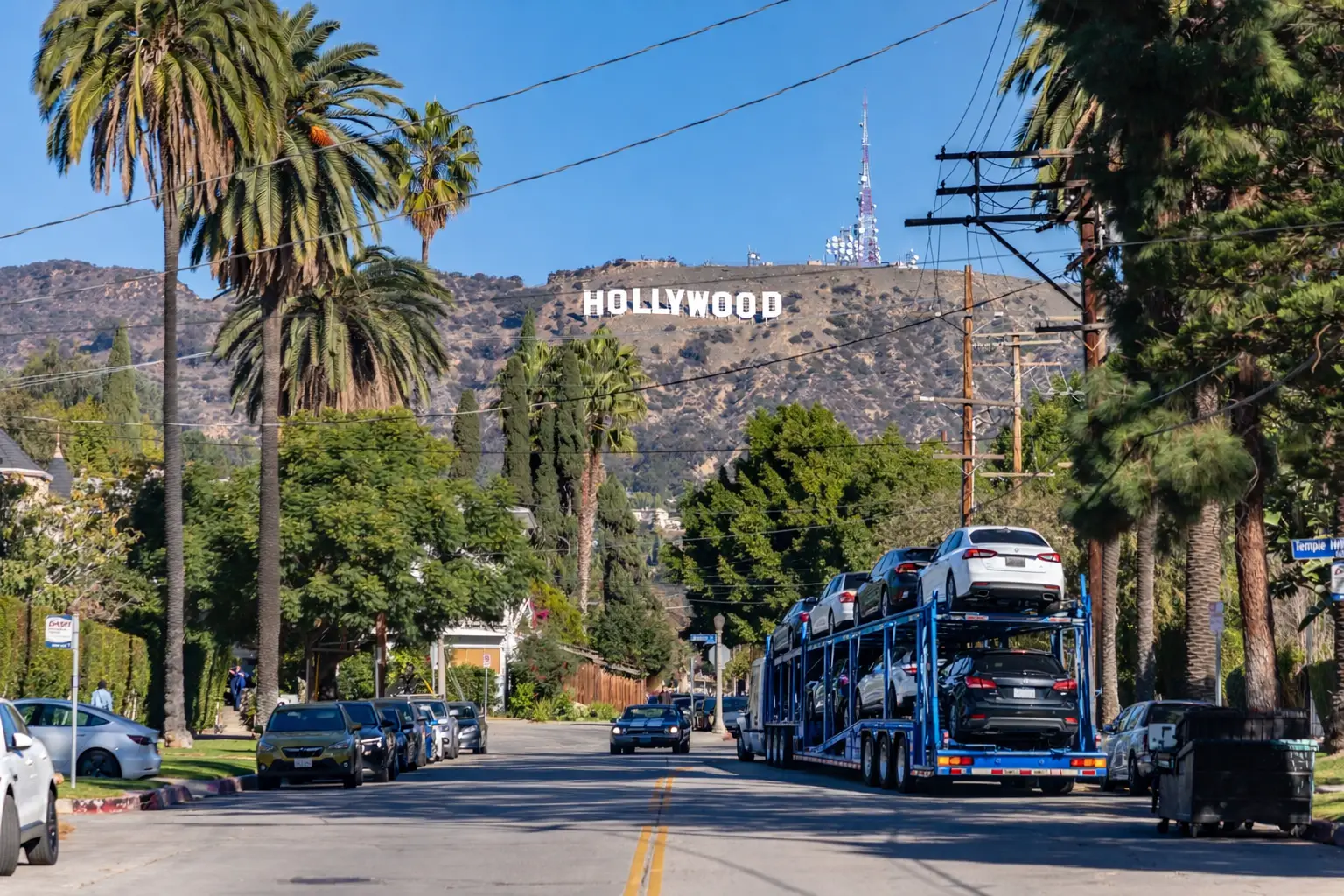
Orlando to Los Angeles Car Shipping
Written by Richard Avery, President of Smart Auto Move · USDOT 2887232 · MC 969368
The cost to ship a car from Orlando to Los Angeles is typically $1,450 to $1,600 on an open trailer, and takes between 7 to 8 days in transit time. It runs almost entirely on Interstate 10, the one transcontinental route that stays clear of snow all year, and it is the only lane we run where both named cities are our own staffed offices.
Smart Auto Move provides nationwide car shipping throughout the lower 48 states, backed by four strategically located staffed offices, six additional service areas, and a trusted carrier network of more than 16,000 transport professionals nationwide. Our extensive network allows us to serve customers across the continental U.S. with reliable vehicle transport from coast to coast.
Service is not currently available in Alaska, Hawaii, or Puerto Rico.
How much does Orlando to Los Angeles car shipping cost?
Every row below is a running mid-size car on an open trailer, reviewed September 2026. Each figure is carried from the route page that publishes it, so nothing here contradicts anything else on the site.
| Route | Also covers | Distance | Days on the road | Open transport |
|---|---|---|---|---|
| Orlando to Los Angeles THIS LANE | The basin, Pasadena, Glendale, Burbank, Long Beach, the Valley | About 2,520 miles | 7 to 8 days | $1,450 to $1,600 |
| Kissimmee to Los Angeles OFFICE TO OFFICE | Celebration, Davenport, St Cloud, Poinciana | About 2,540 miles | 7 to 8 days | $1,450 to $1,600 |
| Orlando to Orange County | Anaheim, Irvine, Huntington Beach, Santa Ana | About 2,540 miles | 7 to 8 days | $1,450 to $1,600 |
| Orlando to San Diego SHORTEST WEST | La Jolla, Chula Vista, El Cajon, Escondido, Oceanside, Carlsbad | About 2,430 miles | 6 to 8 days | $1,450 to $1,600 |
| Tampa to Los Angeles | St Petersburg, Clearwater, Lakeland | About 2,600 miles | 7 to 9 days | $1,475 to $1,625 |
| Los Angeles back to Orlando and Kissimmee THE RETURN LEG | All of Central Florida | About 2,552 miles | 7 to 8 days | $1,425 to $1,575 |
| Orlando to San Francisco or the Bay Area | Oakland, San Jose, the peninsula | About 2,990 miles | 8 to 10 days | $1,825 to $1,975 |
| Orlando to Sacramento LONGEST | Stockton, Modesto, the delta | About 2,850 miles | 7 to 10 days | $1,825 to $1,975 |
| Any route over 2,500 miles NATIONAL BAND | Los Angeles, San Diego, San Francisco, Seattle | Over 2,500 miles | 7 to 10 days | $1,600 to $2,500 |
Read these as estimates rather than fixed prices. Diesel is the largest single cost in hauling a car and it tracks the market, so the rows get reviewed against it. Road days start when your pickup window closes. Enclosed adds roughly 80 percent. A car that will not start needs a winch truck, which adds $200 or more. See how our national bands work.
The Orlando to San Diego and return-leg figures come from our Orlando to San Diego page, and the Sacramento figure from our Sacramento to Orlando page. Winter Park, Lake Nona, Altamonte Springs, Sanford, Clermont and Haines City all price with the Orlando row.
Why this comes in under our own national band
Look at the last row of the table and then at the first. Our published band for a trip over 2,500 miles is $1,600 to $2,500, and Orlando to Los Angeles lands under the floor of it at $1,450 to $1,600. That is not a promotion and it is worth explaining properly.
This lane runs on Interstate 10, the only coast-to-coast corridor that stays clear of snow all year. It runs Jacksonville, Tallahassee, Mobile, New Orleans, Houston, San Antonio, El Paso, Tucson and Phoenix into the Los Angeles basin. It carries heavy freight both ways in every month, including the months when the northern routes are closing passes.
Both ends help too. Central Florida is one of the densest vehicle markets in the country, and so is the Los Angeles basin. A driver on this corridor is rarely empty either way. Your car fills a space on a trip that was already happening rather than paying for one.
The honest flip side, because it matters: on a quiet corridor the same distance costs more than the band, not less. Our own Sacramento row shows it. At 2,850 miles it runs $1,825 to $1,975, well inside the band, because northern California is reached by a thinner route with real winter on it. That is why we measure corridors one at a time rather than asking you to take an average on trust.
Orlando to Los Angeles Car Shipping Questions
The questions this lane really generates, answered with its own numbers.
How much does it cost to ship a car from Orlando to Los Angeles?
The cost to ship a car from Orlando to Los Angeles is typically $1,450 to $1,600 on an open trailer, and takes between 7 to 8 days in transit time. That is for an operable mid-size vehicle. Kissimmee, Winter Park and Celebration all price the same, and the return leg runs $1,425 to $1,575.
How long does Orlando to Los Angeles car shipping take?
Seven to eight days on the road once the car is loaded. That works out to about 315 to 360 miles a day. It is what a driver legally covers under federal hours-of-service rules, with stops and other deliveries along the way. Add your pickup window to that for the full door-to-door timeline.
How far is Orlando from Los Angeles by road?
About 2,520 miles. Kissimmee adds roughly 20 and Tampa about 80. The return leg measures 2,552 miles, because the routing out of the basin differs slightly from the routing in. San Diego is shorter at 2,430 miles.
Do you have offices at both ends of this lane?
We do, and this is the only lane we run where both named cities are ours. Kissimmee is at 2095 E Irlo Bronson Memorial Hwy, Kissimmee, FL 34744, on 407-377-6073. Los Angeles is at 5111 Harold Way, Suite 301, Los Angeles, CA 90027, on 213-766-0064. Both are staffed offices.
Is your Florida office in Orlando or Kissimmee?
Kissimmee, about 18 miles south of downtown Orlando. We would rather name the real town than claim an Orlando street address we do not hold. For a delivery the two are the same market, and carriers price all of Central Florida as one zone.
Why is this cheaper than your national band for the distance?
Because the band is an average and this corridor is much busier than average. Our published band for a trip over 2,500 miles is $1,600 to $2,500, and Orlando to Los Angeles comes in under the floor of it. Interstate 10 is the one transcontinental route that stays clear of snow all year, so it carries heavy traffic both ways every month.
Does that mean the band is wrong?
No, it means it is a national average. On a quiet corridor the same distance costs more than the band, and on a busy one it costs less. That is exactly why we publish measured figures per route where we have done the work rather than asking you to take a band on trust.
Which route does the truck take?
I-4 west out of Orlando, then briefly I-75, then I-10 almost the whole way. Tallahassee, Mobile, New Orleans, Baton Rouge, Houston, San Antonio, El Paso, Tucson and Phoenix, then straight into the Los Angeles basin. It is the southern transcontinental route.
Does weather affect this lane?
Very little, and that is the best feature of this route. Nothing on I-10 climbs a mountain pass, so January looks much like June. A driver plans around two things. Hurricane season at the Florida end, which we watch and keep you posted on. And night running across Arizona in July and August, which is a scheduling detail rather than a delay.
Is Kissimmee the same price as Orlando?
Effectively yes. Kissimmee is 18 miles south and carriers treat the whole of Central Florida as one delivery zone. Winter Park, Celebration, Davenport, Lake Nona, Altamonte Springs and St Cloud all sit in the same range. Pick the address that suits you rather than the one you think prices better.
Where in the Los Angeles area do you deliver?
Across the basin and beyond. Downtown, Hollywood, Silver Lake, the Valley, Pasadena, Glendale, Burbank, Long Beach, Torrance, Santa Monica, plus Orange County including Anaheim, Irvine and Huntington Beach, and out to the Inland Empire.
Can the truck reach my Los Angeles street?
In most of the basin, yes. The Valley, South Bay, Orange County and the Inland Empire all load easily. The exceptions are the hillside streets above Hollywood, Silver Lake and Laurel Canyon, laid out for much smaller vehicles, and buildings with underground-only parking. There the driver picks a wider street nearby and meets you.
What about pickup in Orlando or Kissimmee?
Most of Central Florida takes a full-size carrier at the curb. The exceptions are the gated communities and vacation-home loops around Kissimmee, Celebration and Davenport, built with narrow turns a 75-foot trailer cannot make. The driver picks a wide lot nearby, often off US-192. Tell your gate to expect a carrier and it is a five-minute job.
How quickly can you collect my car?
Our standard pickup window is 6 days from booking. Expedited narrows it to 3 days, which is 72 hours. Central Florida is a heavy inbound and outbound vehicle market, so collection here often happens toward the front of the window rather than at the end of it.
Is expedited worth it on a coast-to-coast run?
It is a thinner benefit here than on a short lane and we will say so rather than sell it to you. Expedited cuts the pickup window from six days to three. It does not speed up the drive, because drivers work to federal hours-of-service limits. When the drive is already a week, three days off the front is useful but not transformative.
What is open transport?
The familiar two-level trailer carrying nine or ten cars, and every price on this page is an open price. It moves the large majority of cars on this lane and it is the same equipment dealers receive new inventory on. Your car picks up road dust across 2,520 miles and arrives wanting a wash, which is the whole of the downside.
How much more is enclosed to Los Angeles?
Enclosed runs about 80% more than open. Against $1,450 to $1,600, expect somewhere around $2,600 to $2,875. The car travels inside a closed trailer with no weather and no grit the entire way. It is the right call for a collector car, an exotic, anything low to the ground, or fresh paint.
Is enclosed worth it on this route?
It depends on the car rather than the distance, and here is the honest version. I-10 has no salt and no mountain weather, so an open shipment on this lane arrives in better shape than one crossing the northern routes in winter. Enclosed earns its money on a valuable finish or a low car, not on the length of the trip.
Can you move a car that will not start?
Yes. It needs a trailer with a winch and a driver equipped to use it, and we have plenty of both. Budget $200 upward on top of the running price. Three answers decide which rig we send, so have them ready: does it roll, does it steer, does it brake.
What does an SUV or pickup add?
A mid-size SUV usually adds $75 to $150 over the ranges here. A full-size pickup or a three-row SUV such as a Suburban or an F-250 typically adds $150 to $300. Trailers are limited by height and weight, so a bigger vehicle takes room the driver could otherwise sell.
Can I ship an electric vehicle?
Yes, and this is a busy lane for them in both directions. Bring it to about half charge, give us the exact model so the weight is right, and switch off anything that wakes the car while it sits. The heavier EVs price a little above a comparable gas car, because weight is what a trailer is limited by.
Is my car insured the whole way?
Your vehicle moves under the assigned carrier's Carrier Cargo Insurance, live from loading in Florida to unloading in California with nothing uncovered between. We confirm each carrier's coverage is active before dispatch and we will email you the certificate for your specific carrier whenever you ask.
What is your USDOT and MC number?
Smart Auto Move operates under USDOT 2887232 and MC 969368. Both are public on the FMCSA SAFER system, and we would rather you checked them than took our word for it. Looking those numbers up is the quickest way to tell a real transport company from a website.
How long do I have to register the car in California?
Twenty days. The California DMV states that you must register a vehicle within 20 days of becoming a resident or bringing it into the state. That is tighter than most states allow, which is a good reason to have the car land with you rather than weeks later.
Does my car need a smog check in California?
Most likely yes. A smog check is required for gasoline 1976 and newer year models, diesels from 1998 and newer under 14,001 pounds GVWR, and natural gas or propane vehicles under 14,001 pounds. A 1975 or older gasoline car and any electric vehicle are exempt.
Does California inspect the car itself?
Yes, and it is quick. California asks for a Verification of Vehicle, DMV form REG 31. An authorized DMV employee, a law enforcement officer or a California-licensed vehicle verifier can complete it. Both the smog check and that verification need the physical car, so the order is: car into California, then smog, then REG 31, then the DMV.
Can the car arrive before I do?
Yes, and on this lane it helps. Two of the three California paperwork steps need the vehicle physically in the state, so having it there early turns the registration into one errand. Send it to a relative, a friend, a workplace or a short-term rental and give us the delivery contact at booking.
Does someone need to be there at both ends?
Someone does, and it need not be you. Any responsible adult will do: a partner, a relative, a neighbor, a building manager, a coworker. They hand over or receive the keys, walk the car with the driver and sign the condition report. Give us their name and a cell number at booking.
Can I leave belongings in the car?
Usually yes, within reason. Keep it to around a hundred pounds, in the trunk and below the window line so the driver can see out. Carrier Cargo Insurance covers the vehicle rather than its contents, so anything valuable or hard to replace travels better with you.
How should I prepare the car?
Wash it, because dirt hides the marks the condition report should record. Leave about a quarter tank of fuel. Turn the alarm off. Then photograph all four corners, the roof and the wheels in daylight. Five minutes of that makes the handover in California simple.
What is the condition report?
It is the inspection you and the driver both sign at pickup, recording every existing mark on the car, and sign again at delivery. Keep your copy. Compare the car against it in good light before you sign it off, and take your own photographs again while you are there.
What if something is wrong at delivery?
Note it on the condition report before the driver leaves, photograph it, and call us that day. That written note at the curb is what makes a Carrier Cargo Insurance claim straightforward, and we file it with the carrier for you. It is uncommon and it resolves much faster when the paperwork happens on the spot.
Does the car change trailers along the way?
Not with us. Whoever loads it in Florida unloads it in California. No second company partway, no night in a storage yard in Texas. Damage in this business clusters at exactly that transfer, so a route without one removes the opportunity rather than insuring against it.
Can I reach the driver on the road?
You get the driver's name and direct number once the carrier is assigned, which across 2,520 miles is more useful than a dot on a map. Drivers will tell you roughly where they are and give you a real delivery window about a day out. With offices at both ends, there is always someone local to call.
Can I ship two cars together?
Yes, and it usually beats two separate bookings. Two vehicles from one Central Florida address to one Los Angeles address save the driver two stops, and that efficiency shows up on the second car. Ask for both at quote time and we will price them as a pair.
How does payment work?
A deposit goes on a card once the carrier is assigned, and the balance is settled with the driver at delivery. That balance is usually cash, a cashier's check or a money order, and your driver confirms which they take when the delivery window is set.
Will the final price match the quote?
Yes. The price we quote is the price you pay, as long as the vehicle, the route, the condition and the shipping details stay the same. That is the Smart Price Promise. What changes a quote is a change in the facts, so tell us early and we re-price it before dispatch rather than after.
Where is Smart Auto Move based?
Registered business address: 4208 Six Forks Rd Ste 1000, Raleigh, NC 27609. Our four staffed offices are in Lakewood, Washington; Los Angeles, California; Chicago, Illinois; and Kissimmee, Florida. Two of those four sit on this lane.
How do I get a real price for my move?
Use the form at the top of this page with both ZIP codes, the year, make and model, and whether the car runs. You will have a real figure in minutes rather than a teaser rate that moves later. You can also call Kissimmee on 407-377-6073 or Los Angeles on 213-766-0064 and speak to someone at either end.
Both ends of this lane are ours
Smart Auto Move has four staffed offices in the country. This is the only lane we run where the two named cities are both of them.
2095 E Irlo Bronson Memorial Hwy, Kissimmee, FL 34744
407-377-6073 · National line 888-709-9078
At the pickup end, about 18 miles south of downtown Orlando. An office rather than a yard, so your car is collected at your own address.
5111 Harold Way, Suite 301, Los Angeles, CA 90027
213-766-0064 · National line 888-709-9078
At the delivery end, a few blocks below the Hollywood sign with daily access to the I-5, I-10 and US-101 corridors. Also an office rather than a yard.
One thing we want to be precise about, because others are vague about it. Our Central Florida office is in Kissimmee, not Orlando. For a pickup those are the same market and the price is identical. We would far rather name the real town than claim an Orlando street address we do not hold.
What that buys you on a seven-day drive is simple. People who know Central Florida arrange the collection. People who know the Los Angeles basin pick it up as the truck comes in on I-10. Call either end and you reach someone who has worked this corridor. Your car does not sit anywhere in between either. It goes from your address straight onto the carrier and stays under that carrier's Carrier Cargo Insurance until it comes off in California.
The road that does not close
Most coast-to-coast lanes come with a winter asterisk. This one does not, and it is the main reason the price and the day count hold up all year.
The truck runs I-4 west out of Orlando, drops briefly onto I-75, then picks up I-10 and stays on it. Tallahassee, Mobile, New Orleans, Baton Rouge, Houston, San Antonio, El Paso, Tucson, Phoenix, and into the basin. Nothing on that line climbs a mountain pass. Compare the northern routes, where Snoqualmie, Donner and the Rockies all take snow and a closure can add a day.
Almost nothing. Your February estimate is the same as your July one, and a driver is not waiting out a pass closure in Wyoming. It is the most predictable long lane we publish.
Hurricane season at the Florida end, which can affect a pickup rather than the drive. When it does we watch it and keep you posted rather than leaving you guessing.
One scheduling note about the Arizona stretch in July and August. Drivers often run it at night, because it is easier on the equipment and on them. It does not change your day count. It does mean a delivery may land earlier or later in the day than you expect, and the driver will tell you.
Pickup in Central Florida, delivery in the basin
Both ends have one quirk worth planning around, and they are different quirks.
Gated Florida
Much of the Kissimmee, Celebration and Davenport area was built on narrow resort loops a 75-foot trailer cannot turn in. The driver picks a wide lot nearby, often off US-192. Tell your gate to expect a carrier and it becomes a five-minute job.
Hillside Los Angeles
The streets above Hollywood, Silver Lake and Laurel Canyon were laid out for much smaller vehicles, so the driver loads on a wider street below. The Valley, South Bay, Orange County and the Inland Empire are all straightforward.
Underground parking
Common at both ends and easy to plan for. A loaded carrier cannot enter a garage with a height limit, so the handover happens on the street or in a nearby lot instead.
None of those costs extra. The driver agrees the spot with you in advance, which is why we ask about access at booking rather than on the morning. Central Florida pickups run across Orlando, Kissimmee, Winter Park, Celebration, Davenport, St Cloud, Lake Nona, Altamonte Springs, Sanford, Clermont and Haines City.
There is more on the Florida end at our Orlando car shipping page, and on the California end at our Los Angeles page and the California car shipping page.
California gives you twenty days, and wants the car present
Florida asks nothing of a car that is leaving. California asks a bit more of one arriving, and two of the three steps need the vehicle physically in the state.
- You must register the vehicle within 20 days of becoming a resident or bringing it into the state, according to the California DMV. That is tighter than the thirty days most states allow.
- A smog check from a California smog station is required for gasoline 1976 and newer year models. Also diesels from 1998 and newer under 14,001 pounds GVWR, diesel hybrids included, and natural gas or propane vehicles under 14,001 pounds. Motorcycles are exempt.
- Exempt from smog altogether: a gasoline vehicle that is a 1975 year model or older, a diesel that is 1997 or older or over 14,000 pounds, a natural gas vehicle over 14,000 pounds, and any electric vehicle.
- The car needs a Verification of Vehicle, DMV form REG 31, completed by an authorized DMV employee, a law enforcement officer or a California-licensed vehicle verifier.
So the order is simple. Get the car into California, then the smog check, then the REG 31 verification, then the DMV. Both middle steps want the vehicle in front of someone. On a seven-day lane that is the practical argument for shipping it to land with you rather than weeks later.
Keep your Florida coverage in force until the California policy starts. The car travels under the carrier's Carrier Cargo Insurance, so there is no gap on the trailer. You want none on the driveway either.
Who ships cars on this lane
Relocations
Central Florida and Southern California trade households constantly, in both directions, and a second car almost always ships rather than being driven 2,520 miles.
Hospitality and entertainment
Both metros run on tourism and production work, and both recruit from the other. Relocation packages frequently cover one vehicle.
Snowbirds and students
Some customers keep a car at each end and run the same pair of moves every year. UCF and the California universities also trade students in August and May.
Our student discount page and military car shipping page cover two of those cases. Running this route seasonally? Ask about both legs at once, because the return is only $25 either side of the outbound.
How Orlando to Los Angeles auto transport works
Get your price
Send the Central Florida pickup ZIP, the California delivery address, the vehicle and your earliest date.
Book the move
A deposit opens your six day pickup window on the first date you gave us.
We assign a carrier
You get the driver's name and direct number, and the insurance certificate if you want it.
Loading in Florida
Walk the car with the driver, sign the condition report, watch it go up the ramp.
Seven to eight days west
I-10 the whole way, with calls, texts and email along the route.
Delivery in the basin
Check the car against the pickup report, settle the balance, take the keys.
Open, enclosed or expedited to Los Angeles
Open transport carries almost every car on this lane and all the prices here are open prices. Enclosed is the choice for a collector car, an exotic, a low car or fresh paint. Budget about 80 percent above the open figure.
Here is the honest version of the enclosed question on this route. I-10 has no salt and no mountain weather, so an open shipment arrives in noticeably better shape than one that crossed the northern routes in February. Enclosed earns its money here on a valuable finish or a low car, not on the length of the trip. We would rather say that than sell you a trailer you do not need.
Expedited narrows the pickup window from six days to three. The drive does not shorten, because drivers work to federal hours-of-service limits. On a lane where the drive is already a week, three days off the front is useful but it is not transformative, and we will say so. The open and enclosed guide covers the trailer choice and the standard versus expedited guide covers the timing one.
A car that will not start ships perfectly well. It loads on a winch, which adds $200 or more to the running price, and telling us at quote time means the right truck is assigned from the start.
The carrier behind your shipment
One carrier from our vetted network of over 16,000 runs the whole distance, with no transfer in Texas and no night in a storage yard. Active FMCSA authority and a live insurance filing come first and nothing moves without both. After that comes the trailer, how often that driver works the I-10 corridor, and how their recent deliveries went.
That carrier's Carrier Cargo Insurance covers your vehicle from the Florida pickup to the California delivery, and the certificate is yours on request. Our own record is public on SAFER at USDOT 2887232, MC 969368.
What customers on this route say
Feedback from people whose cars we have moved between Central Florida and Southern California. There are more on our BBB profile, where our A+ rating and accreditation go back to 2016.




Crystal Evans was very helpful.

More Florida and California car shipping pages
Related lanes and guides.